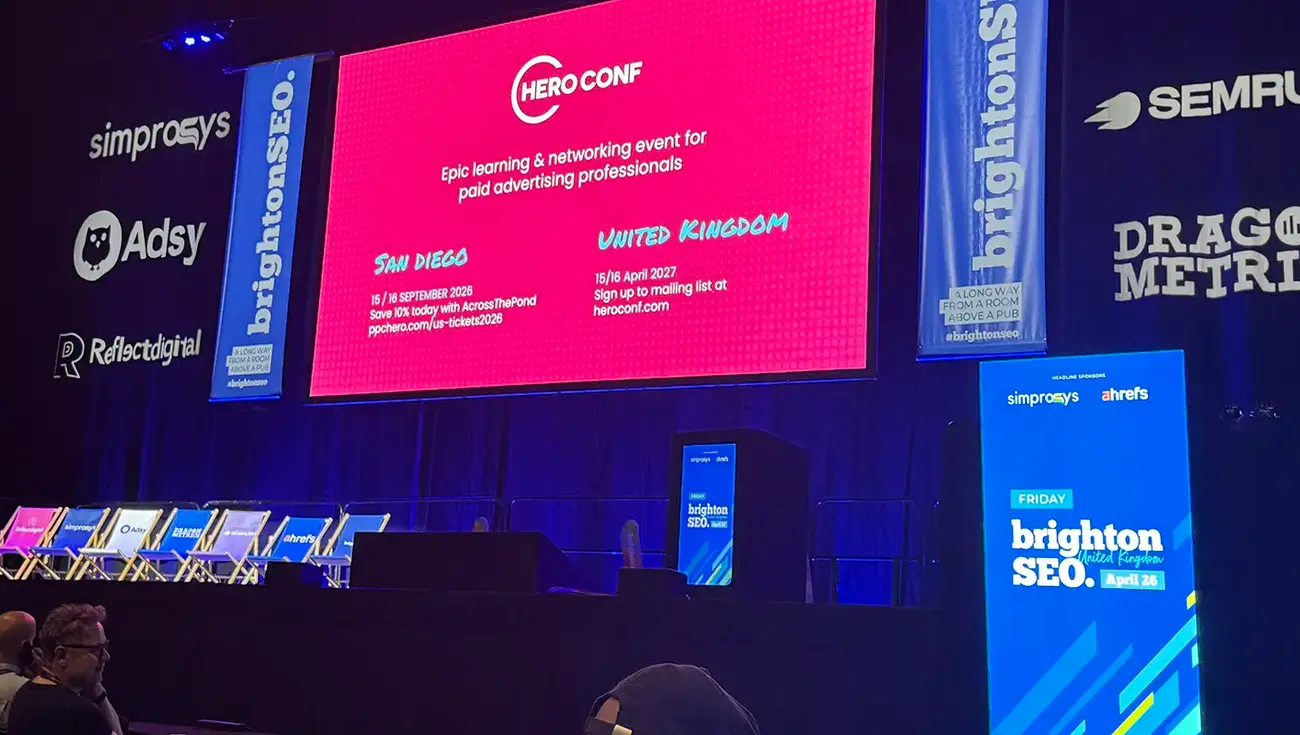

TL;DR: Most of the brightonSEO 2026 conversation was about AI and organic search. We went looking at the other side of the coin: the economics of paid media. Margins are tightening, CPCs are climbing, and the old habit of setting up a Google Ads account and leaving it to run is no longer a strategy.
Here are the 10 paid media takeaways we're folding into client work over the coming weeks, and what each one means in practice.
At A Glance
Copy shareable section link- The Shift: From ROAS to POAS (Profit on Ad Spend), so you scale the campaigns that actually grow profit.
- What's Changing: AI Overviews are pushing previously free organic traffic into the paid auction, and CPCs are compounding faster than budgets are growing.
- The New Job: Tighten measurement, fix tracking gaps, and stop paying twice for traffic you already win organically.
- Our Stance: Treat the landing page, ad copy and tracking layer as part of the auction. Multiply marginal gains rather than chase single-lever bid changes.
Why This Matters Now
Paid auctions are getting more expensive at the same time as tracking is getting weaker. AI Overviews are eating into free organic traffic, automated campaign types like Performance Max are bidding aggressively on your behalf, and browser changes are quietly removing conversion data from your reports. Doing the same thing you did last year now costs more and tells you less.
The good news: most accounts have meaningful wins available before any extra spend, if the right things get fixed in the right order.
The 10 Strategies
Copy shareable section link-
Shifting From ROAS To POAS (Profit On Ad Spend)
Your Return on Ad Spend dashboard can mislead. The keywords generating the highest ROAS often deliver some of the lowest actual profit margins, because revenue does not equal profit.
What we're doing for clients: moving beyond surface-level ROAS to measure Profit on Ad Spend (POAS). By understanding the true margin behind every click, we can confidently scale the campaigns that grow the bottom line and cut the ones that only look good on paper.
-
Eliminating The Double Pay Penalty
Many brands accidentally pay twice for the same traffic. It is common to find thousands of pounds being spent each month bidding on search terms where the business already ranks organically in positions 1 to 3.
What we're doing for clients: using integrated analytics to identify exactly where paid and organic visibility overlap, then pausing bids on terms you already dominate for free and reallocating that budget into incremental growth.
-
Escaping The MarTech Trap With Server-Side Tracking
Ad blockers, browser restrictions and cookie consent rules mean traditional tracking pixels miss a meaningful share of your conversion data. If the ad platform thinks a campaign is underperforming, it stops spending, even when that campaign is quietly driving sales.
What we're doing for clients: upgrading the measurement layer with Enhanced Conversions and the Conversions API (CAPI). Moving to server-side tracking restores the missing signals so the algorithms can optimise spend against accurate data.
-
Preparing For Compounding CPCs, Not Just Rising Ones
If you've planned for a 3 percent CPC rise this year, you're already behind. Portfolio data shared at the event put average CPCs compounding at around 18 percent, with automated formats like Performance Max closer to 28 percent [stat needs source].
What we're doing for clients: tightening audience targeting and ad relevance so you don't overpay for unqualified clicks while AI Overviews push more previously free traffic into the paid auction.
-
Answering The Literal Question
The worst-performing ad is the one that answers a question the user did not ask. If someone searches for a specific product, vague brand-led ad copy forces them to translate marketing language back into their actual need before they click.
What we're doing for clients: running "Effort Audits" on ad copy. If a user searches for "size 10 running shoes", our ads confirm fit, price and delivery clearly, so the cognitive load to click is as low as possible.
-
Measuring The Arrival Rate
A click is not a visit. Arrival Rate measures landing page views divided by link clicks. If your page is slow to load or noisy above the fold, a real chunk of paid clicks never become real sessions.
What we're doing for clients: treating the landing page as part of the auction. We audit page speed and above-the-fold clarity so every click you pay for actually arrives as a qualified visitor.
-
Multiplying Marginal Gains
In paid media, small improvements multiply rather than add. A 5 percent lift in click-through rate, combined with a 5 percent lift in arrival rate and a 5 percent lift in landing page conversion rate, compounds to roughly a 15.8 percent uplift in total leads with no extra media spend.
What we're doing for clients: optimising the full journey, from creative to checkout, knowing that the CPC isn't the biggest cost. The biggest cost is the traffic you haven't made easy enough to convert.
-
Rebalancing The 70/20/10 Budget Split
Many businesses default to roughly 70 percent of budget on paid, leaving organic and AI search underfunded. Data shared at the event suggested a more balanced split, closer to 45 percent paid, 30 percent organic and 25 percent AI search, is more resilient and more cost-effective over time [data source needs attribution].
What we're doing for clients: looking at the total digital footprint to make sure you aren't over-reliant on expensive paid clicks, and unifying the data so we can forecast where reallocating budget (PPC into GEO, for example) will give the highest return.
-
Treating Impressions As Influence
It's easy to value only the paid media that generates a direct click. Top-of-funnel ads, much like billboards or TV in their day, often don't produce an instant click but heavily influence later behaviour.
What we're doing for clients: broadening attribution. High-visibility paid social and display ads seed brand awareness, and users often convert later through a direct search or an AI recommendation without ever clicking the original ad.
-
Expanding Into Bing Ads
Google is no longer the only paid auction worth your attention. As AI changes discovery and ChatGPT search leans heavily on Bing, Microsoft Advertising is becoming a meaningful channel rather than a curiosity.
What we're doing for clients: diversifying paid strategies into Microsoft Advertising where audience and intent justify it, so high-value searches don't only get captured on a single platform.
What This Means For Your Business
Copy shareable section linkThe era of setting up a Google Ads account and leaving it on autopilot is over. AI is reshaping the auctions, the tracking layer is leakier than it used to be, and the cost of inattention is rising every quarter. The brands that win paid media in 2026 will be the ones measuring profit (not just revenue), fixing their tracking properly, removing wasted spend on organic overlap, and treating ad copy and landing pages as part of the same auction.
Most accounts can find meaningful wins before any uplift in spend. That's the work we're doing for clients now.
Key PPC Takeaways
Copy shareable section link- Measure Profit on Ad Spend (POAS), not just ROAS, so you scale on margin rather than revenue.
- Audit paid and organic overlap to stop paying for traffic you already win for free.
- Fix tracking with Enhanced Conversions and server-side CAPI so the algorithms optimise against real data.
- Plan for compounding CPCs, not 3 percent rises. AI Overviews are pushing free traffic into the paid auction.
- Treat ad copy, landing page speed and arrival rate as part of the auction, not a separate job.
References And Further Reading
Copy shareable section link- brightonSEO 2026 official programme
- POAS case study reference: [speaker / study needed]
- Compounding CPC and Performance Max data: [portfolio source needed]
- 70/20/10 versus 45/30/25 budget split data: [study source needed]
- Arrival Rate framework reference: [speaker / source needed]
Related Doublespark Services
Stop Paying For Clicks. Start Paying For Growth
Doublespark has been running paid media campaigns for clients across the UK since 2005 [founding year needs confirming]. The combination of rising CPCs, AI-driven auctions and tracking gaps means most accounts now have material wins available before any uplift in spend, if the right things are fixed in the right order.
If you want a clear, profit-led view of where your paid budget is leaking and what to do about it, get in touch.