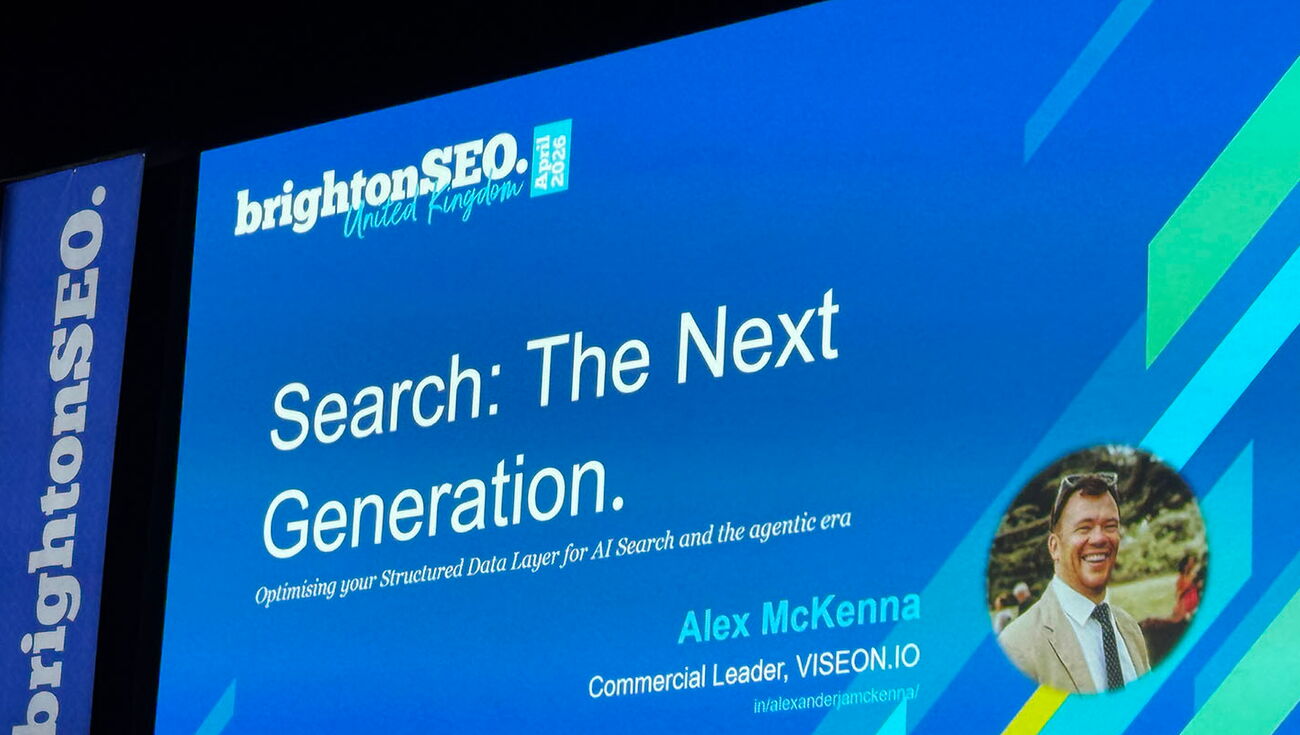

TL;DR: BrightonSEO 2026 wrapped up last week. We were there for both the main conference and the Advanced GEO & AI Optimisation workshop. After three days of talks, workshops and conversations, one message kept landing: search is fragmenting, and ranking on Google is no longer the same job as being found by your customers.
Here are the ten takeaways we're folding into client work over the coming weeks, and what each one means in practice.
At A Glance
Copy shareable section link- The Shift: From keyword rankings to citation share inside AI answer engines.
- What's Changing: Buyers now research across YouTube, Reddit, ChatGPT, Perplexity, Gemini and Claude, often well before they land on a website.
- The New Job: Get your brand recognised by the models so you make their shortlist.
- Our Stance: Run Generative Engine Optimisation (GEO) and Answer Engine Optimisation (AEO) side by side, and keep the conversion rate basics tight.
Why This Matters Now
Copy shareable section linkIf your visibility report still measures only Google rank, it's measuring a smaller slice of the picture every quarter. AI answer engines, social platforms and specialist search tools are taking real share of the discovery journey, and they each behave differently. Treating "AI search" as one thing isn't enough.
The Ten Strategies
Copy shareable section link
-
From Keywords To Conversations
The old game was fighting over a small set of high-volume keywords. The new game is showing up in the nuanced, conversational queries users type into AI tools. According to research shared at the event, around 60 percent of AI prompts are now 10 words or longer [stat needs source].
What we're doing for clients: shifting content towards specific, question-led pages that cover the who, what, why, when, where and how of a real customer problem, rather than chasing the same keyword as everyone else.
-
Optimising For Citability, Not Just Rankings
You're no longer only competing for a position on a search results page. You're competing to be the source an AI model quotes inside its answer.
What we're doing for clients: making content easier to cite. That means clear factual statements, named locations and concrete details where relevant, fewer sweeping claims that AI models tend to skip over, and information structured so it can be lifted directly into an answer.
-
The Search Everywhere Mindset
Discovery is spread across YouTube, TikTok, Reddit and AI tools, alongside Google. Some speakers framed this as Search Everywhere Optimisation, or SEOx.
What we're doing for clients: deciding which entity or topic a brand should be known for, then making sure that brand shows up consistently wherever buyers actually look. Recognition matters as much as ranking.
-
Different LLMs Need Different Strategies
The same brand can be cited very differently across AI models. Sessions at the event suggested that Gemini tends to favour the brand's own website, Perplexity behaves more like a traditional search tool with heavier web citation, and Claude leans on user-generated content, forums and reviews [model behaviour claims need source attribution].
What we're doing for clients: identifying which models the target audience uses most, then tailoring content, citations and technical signals for those models, rather than treating AI as one thing.
-
Citation Share Of Voice
Traditional visibility reports often measure the wrong thing. They show your rank against a handpicked competitor list, which misses the brands your customers are actually being recommended by AI.
What we're doing for clients: building AI Share of Voice tracking with an open denominator. Rather than only comparing you to three or four named competitors, we measure how often you're mentioned against every brand AI models choose to cite in your sector.
-
The Collapsed Buying Journey
AI is shortening the research phase. Buyers often arrive at a shortlist before any humans on your side know they exist, because the model picked the shortlist for them.
What we're doing for clients: getting your brand into that shortlist phase. That means topical depth, clear entity associations, and the kind of supporting signals that influence which names a model surfaces.
-
Authority That Can't Be Copied
Authority is the ability to change behaviour. If your content just rewords what already ranks, an AI model has no real reason to credit you over anyone else.
What we're doing for clients: building content around owned data, first-hand research, named experts and direct delivery experience. That's what makes a brand worth citing.
-
Third-Party Platforms Carry More Weight Than Ever
Sessions at the event pointed to Reddit, Wikipedia, Forbes, Medium and LinkedIn as some of the most frequently cited sources in AI answers [study source needs attribution].
What we're doing for clients: building presence beyond your own domain. Reviews, expert contributions and consistent mentions on high-authority platforms feed back into how AI models talk about you.
-
GEO And AEO Are Separate Jobs
Two strategies sit alongside each other. Generative Engine Optimisation (GEO) is about clear, in-depth pages and FAQs that inform the models. Answer Engine Optimisation (AEO) is about technical structure: schema, semantic clarity, clean markup, so machines can lift the answer cleanly.
What we're doing for clients: running both in parallel. Write for humans first, wrap the structure to be machine-ready second.
-
The Conversion Basics Still Pay
Even with the AI focus, the fastest revenue gains usually come from tightening conversion basics. Ad copy that matches the landing page, fewer form fields, sticky mobile calls to action, faster pages. None of it is glamorous. All of it works.
What we're doing for clients: pairing the AI search work with quick conversion checks, so the traffic you already have works harder while the longer AI visibility job builds.
What This Means For Your Business
Copy shareable section linkIf your visibility report still tracks only Google rank, it's measuring a smaller slice of how customers find you each quarter. The brands that win the next 18 months will be the ones cited by AI engines, present on the third-party platforms those engines lean on, and easy to convert once a visitor does land.
That's the job we're building into client work now!
Key Takeaways
Copy shareable section link- AI answer engines change the goal from ranking to being cited.
- Each model behaves differently and rewards different content patterns.
- Search is happening across YouTube, Reddit, social and AI tools, not only Google.
- Citation Share of Voice with an open denominator beats narrow competitor rank reports.
- CRO and conversion basics still deliver the fastest revenue gains.
References And Further Reading
Copy shareable section linkBrightonSEO 2026 official programme
Advanced GEO & AI Optimisation workshop
Related Doublespark services:
Ready To See Where You Stand In AI Search?
Doublespark has been working in search since 2005, the shift to AI-driven answer engines is the biggest change to discovery we've seen, and it rewards getting started early.
If you want a clear picture of how your brand currently appears across AI tools, alongside an SEO audit, get in touch and we'll walk you through it.