
Generative AI has changed how people discover and evaluate information. Increasingly, your next customer may never click a blue link - they’ll read a composed answer in Google’s AI Overviews, a summarised panel in Bing’s Copilot Search, or a concise response from Perplexity. That shift demands a complementary discipline to classic SEO: AI Optimisation - the craft of making your brand selectable, quotable, and citable by answer engines.
This guide explains what’s changed, what hasn’t, and how UK businesses can build AI visibility that translates into enquiries and revenue - without chasing gimmicks or abandoning proven fundamentals.
Quick definition
Copy shareable section linkAI Optimisation
A practical set of content, technical and reputation tactics that make your pages easy for generative and answer engines to discover, understand, and confidently cite in their responses. It focuses on earning inclusion in AI Overviews, Copilot answers, and similar zero‑click services, not only traditional rankings.
Related terms:
- Generative Engine Optimisation (GEO): Ensuring content is selected and cited by generative engines.
- Answer Engine Optimisation (AEO): Structuring content so answer engines can extract and present direct answers.
- Zero‑click services: On‑platform experiences (e.g., AI answers, snippets) that satisfy the query without a website click.
What’s really changed - and what hasn’t
Copy shareable section link- Changed: Users get synthesised answers, driven by entities, citations and passage‑level understanding, not just whole‑page rankings.
- Changed: Answer engines increasingly show sources and link to supporting pages inside the AI panel itself (your brand can win visibility even when clicks are fewer). See Microsoft’s overview of Copilot Search and its citations.
- Changed: Zero‑click behaviour is rising. Independent studies show a growing share of searches end without a click, driven by AI Overviews, featured snippets and other SERP features - for example, Semrush’s analysis of zero‑click searches.
- Not changed: Google still expects people‑first, helpful content that demonstrates E‑E‑A‑T (Experience, Expertise, Authoritativeness, Trust). See Google’s guidance on creating helpful, reliable content.
- Not changed: For Google’s AI experiences, there are no special technical tags or “AI schema” to add. Standard SEO eligibility (indexing, snippets allowed, good page experience, aligned structured data) still applies, and performance is visible in Search Console.
How answer engines assemble answers (in plain English)
Copy shareable section link- Interpret the question (including context from prior turns in chat).
- Fan out to related sub‑queries, retrieve candidate sources, and evaluate specific passages.
- Synthesise a draft answer, often with inline citations (e.g., Copilot Search, Perplexity).
- Display a composed response plus suggested follow‑ups. Many users stop there -hence the growth of zero‑click services—but brand exposure within these panels still influences trust and downstream conversions.
What this means for you: your content must be discoverable, machine‑parsable, and quotable - with clear claims, evidence, and context that engines can confidently attribute.
The AI Optimisation playbook (12 practical steps)
Copy shareable section link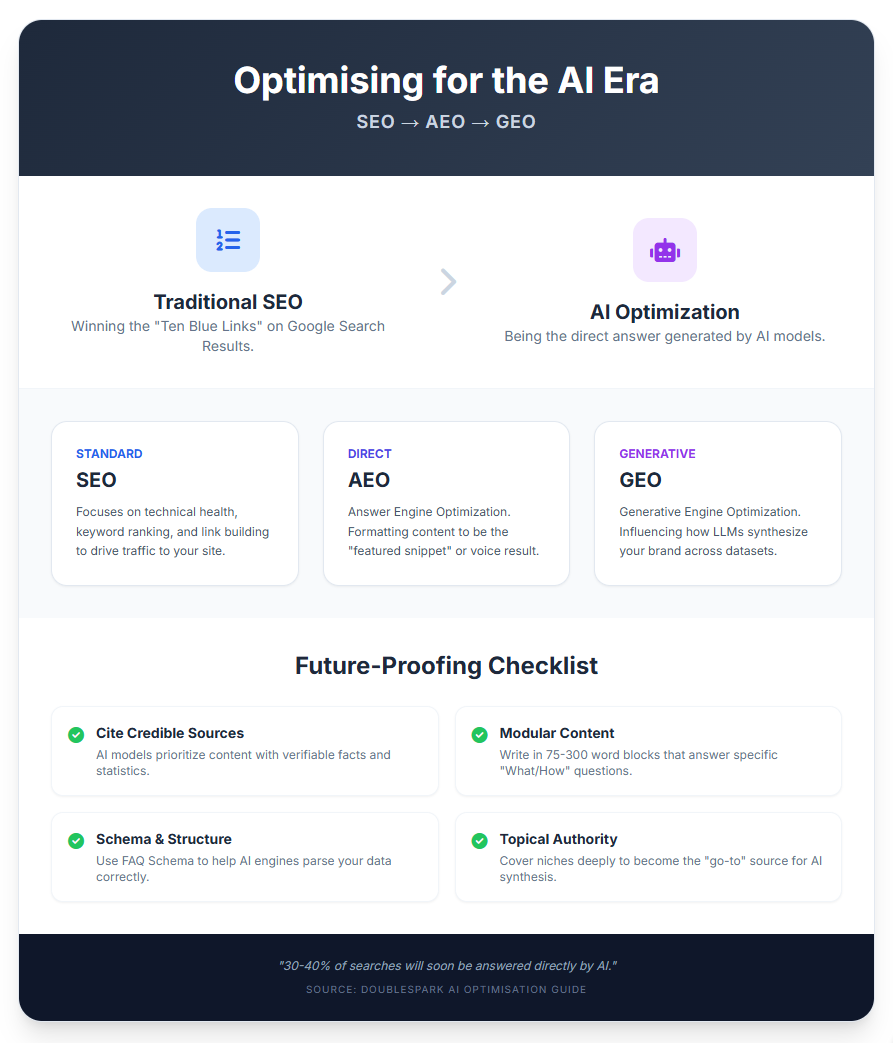
1) Start with people‑first content (E‑E‑A‑T)
Prioritise content that clearly answers real customer questions, shows first‑hand experience, and states who wrote it, how it was created (including any AI assistance where appropriate), and why it exists. This aligns with Google’s helpful‑content guidance.
- Add bylines, author bios, and sources.
- Include evidence: photos, data, methods, examples, and UK‑specific nuance.
2) Make your pages “answer‑ready”
Engines prefer passages that resolve a question quickly.
- Open with a one‑paragraph definition or executive summary.
- Use FAQ‑style sub‑headings (“What is…”, “How to…”, “Pros and cons”).
- Provide numbered steps and checklists that are easy to quote.
3) Focus on entities, not just keywords
Answer engines map people, organisations, products, and places and their relationships. For a practical primer, see Ahrefs’ explainer on entity‑based SEO.
- Clarify who you are: consistent organisation name, address, and profiles (e.g., LinkedIn).
- Reinforce connections with internally consistent naming and contextual links across your site.
4) Keep the fundamentals: crawlability & eligibility
AI panels can only cite what search engines can access.
- Allow crawling in
robots.txt, serve stable 200 status, and supply XML sitemaps. - Ensure your structured data matches visible text (don’t mark up what isn’t on the page).
5) Use structured data to clarify, not to game
There’s no “AI Overviews markup”, but well‑implemented schema (e.g., Organization, Person, Product, Review, HowTo, FAQ where appropriate) helps machines understand who said what and why it’s trustworthy.
6) Write for precision and provenance
Engines quote concise, verifiable claims.
- State clear facts with sources, especially statistics and definitions.
- Avoid vague qualifiers; give numbers, ranges, dates, and locations.
7) Publish original data and UK insight
Being cited often starts with something worth citing.
- Commission small UK‑focused studies, pricing benchmarks, timelines, or case studies.
- Offer downloadable templates and checklists that others reference.
8) Improve topical depth & internal linking
Build hub pages with sub‑topics and supporting articles. Internal links help both crawlers and answer engines fan out across your expertise.
9) Optimise media for extraction
- Provide alt text, descriptive filenames, and captions for images and charts.
- Transcribe videos and host the transcript alongside the video.
10) Refresh with intent, not vanity
Update pages when material circumstances change (regulations, pricing, process). Show “Last updated” and summarise what changed. Avoid shallow date‑tweaks.
11) Respect controls & disclosure
If you need to limit previews or training, use established controls (e.g., nosnippet). Manage this carefully so you don’t accidentally remove eligibility from search experiences.
12) Measure what matters
Traffic from AI features can surface under Search Console → Performance → Web. Track impressions/CTR alongside on‑site conversion and engagement metrics; firms often see higher‑quality clicks from AI panels when they do occur. Learn more about the tool at Google Search Console.
If you’d like an expert review, our SEO Audit identifies technical and content issues that limit AI visibility.
Why AI visibility pays - even in a zero‑click world
- Pre‑sell trust: Your brand is presented as part of the “right answer” at the moment of need.
- Shape consideration: Prospects see your frameworks, terminology, and data before they shortlist suppliers.
- Lift branded demand: Even without an immediate click, visibility stimulates brand searches, direct visits, and social shares.
- Drive better clicks: When users do click from AI panels, visits tend to be higher quality (longer engagement, stronger intent).
And the macro trend is real: zero‑click behaviour is increasing, so the marketing value of being included and cited is rising too - see Semrush’s latest zero‑click study.
Content formats that perform in answer engines
Copy shareable section link- Definition cards & glossaries: One‑paragraph explanations plus a short bullet list of essentials.
- Step‑by‑step guides: Actionable, numbered instructions with time and cost estimates.
- Comparisons & decision trees: Side‑by‑side tables, scenario‑based recommendations.
- Original research & statistics: Proprietary UK data earns citations.
- Case studies with outcomes: Quantified impact, methodology, and visuals.
- FAQ clusters: A page that contains the “next ten questions” users ask after the main one.
Technical checklist (fast scan)
Copy shareable section link- Indexing & snippet eligibility: Indexed, canonical set, no accidental
noindex/nosnippet. - Robust internal linking: Hubs → spokes, descriptive anchor text.
- Structured data: Organisation, Person (authors), Product/Service details, HowTo/FAQ when it matches visible content.
- Performance & UX: Core Web Vitals, accessible markup, mobile rendering.
- Clear authorship: Bylines, author pages, and credibility signals (awards, qualifications).
- Transparent creation process: Disclose substantial AI assistance where a reader would reasonably expect it.
GEO vs. classic SEO: do you really need a “new” discipline?
Copy shareable section linkGoogle’s documentation is explicit: there’s no separate markup or special checklist to appear in AI Overviews - the same core SEO principles apply, with an emphasis on helpful, reliable content and eligibility.
That said, AI Optimisation adds practical emphases:
- Write answer‑first and quote‑friendly passages.
- Strengthen entity clarity (who/what/where) across your site.
- Publish material that others will cite (original data, clear definitions).
- Monitor where your brand is mentioned in AI panels (not only SERPs).
Treat GEO/AEO as priorities within SEO, not a replacement for it.
How to structure a page for AI‑driven interfaces (template)
Copy shareable section link- Opening synopsis (75–120 words): Directly answer the primary question.
- At‑a‑glance bullets (3–6): Key facts, constraints, or costs.
- Numbered steps or decision tree: Show process clearly.
- Evidence panel: Data points, examples, or references (with sources).
- FAQ sub‑section: Five to eight specific follow‑ups.
- Who/How/Why box: Author credentials, methodology, last updated.
Measurement & KPIs for AI visibility
Copy shareable section linkWhat you can measure today
- Search Console (Web): Track impressions/clicks where AI features appear. Use Search Console and pair with Analytics conversions/engagement to assess quality.
- Downstream behaviour: Branded searches, direct visits, assisted conversions.
- Manual sampling: Queries in your niche—note where your brand is cited inside AI panels (Google AI Overviews, Bing Copilot, Perplexity).
Targets to consider
- Percentage of priority queries where your brand is featured or cited.
- Share of voice within AI panels (how often you appear vs. competitors).
- Citation quality: Are you credited for definitions, data, or deep guides?
Common pitfalls & myths (and what to do instead)
Copy shareable section linkMyth: You need special “AI schema” to rank in AI Overviews.
Reality: There’s no special schema; focus on eligibility, helpful content, and technical quality.
Myth: Zero‑click means SEO is dead.
Reality: It’s a visibility shift. Earn the citation and nurture the click later via brand recall and follow‑up queries.
Myth: Any AI‑written content will do.
Reality: Google prioritises people‑first pages and encourages transparency about how content was created.
FAQ
Copy shareable section linkWhat is Generative Engine Optimisation (GEO)?
GEO is the practice of making your content selectable and citable by generative answer engines. In practical terms, it means fresher, clearer, evidence‑rich content that engines can quote confidently - plus entity clarity and clean technical foundations.
Do I need special markup to appear in Google’s AI Overviews?
No. Google states there are no additional technical requirements beyond standard Search eligibility. There is no AI‑specific schema to add.
Where do I see AI traffic in my reports?
Appearances from AI features are generally counted in Search Console → Performance → Web. Pair this with Analytics conversions and engagement to assess quality.
Which answer engines matter right now?
At a minimum: Google’s AI Overviews/AI Mode, Bing Copilot Search (with prominent citations), and Perplexity (with numbered sources). Prioritise where your buyers actually search.
Putting it all together: a 30–60–90 day roadmap
Copy shareable section linkDays 1–30: Foundations
- Audit priority pages for answer‑first structure (definition + steps + FAQs).
- Add bylines, bios, and evidence (photos, methodology) to demonstrate experience.
- Fix crawl/index issues; ensure snippet eligibility and aligned structured data.
Days 31–60: Authority & coverage
- Publish original UK‑centric data or a mini‑study in your niche.
- Build hub‑and‑spoke internal linking around key entities and services.
- Pitch the data to relevant publications for earned mentions/citations.
Days 61–90: Measurement & iteration
- Track Search Console Web metrics for target queries and pages.
- Manually sample AI panels (Google, Bing Copilot, Perplexity) for citation presence.
- Improve clarity of definitions and evidence on pages that are seen but not cited.
Trusted resources (contextual external links)
Copy shareable section link- Google’s guidance on creating helpful, reliable, people‑first content (E‑E‑A‑T)
- About Google Search Console (where AI features are reflected under “Web”)
- Microsoft’s Copilot Search announcements and citations overview
- Semrush: Research on the growth of zero‑click searches
- Ahrefs: Entity‑based SEO (how search engines understand concepts)
Conclusion: Beyond rankings—become part of the answer
In an AI‑shaped search landscape, growth comes from being the source worth citing. That’s the heart of AI Optimisation: show expertise with clarity, structure pages for extraction, maintain technical eligibility, and publish credible evidence others want to reference. Do that consistently and you’ll earn AI visibility in zero‑click services and beyond—while still compounding the gains of traditional SEO.
How Doublespark can help
We work with UK organisations to prioritise opportunities, structure high‑impact pages, and build authority that answer engines - and buyers - trust. If you’d value a pragmatic plan tailored to your market, get in touch with Doublespark to explore our AI Optimisation and SEO services.