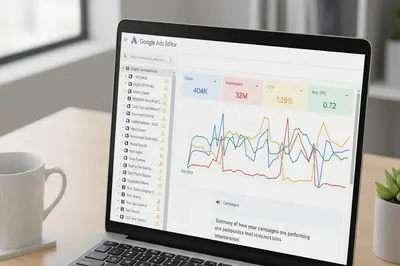

Google Ads Labs is a new section that is being tested inside the Google Ads interface to surface experimental tools and early features for advertisers in one place. Early reports show it appearing at the bottom of the left navigation and including items such as “missed growth opportunities.” Availability is limited while Google trials the experience.
Why this matters now
Copy shareable section linkGoogle has accelerated its advertising roadmap through 2025, with major AI-led updates and faster iteration across campaign types. The Labs hub signals that experimental capabilities will reach advertisers more frequently, and with clearer signposting, than before. That creates an opening for any ppc agency, in‑house team or ppc consultant ready to test responsibly and move winning ideas into production before competitors catch up. Coverage from Search Engine Land confirms the Labs hub test started in late September 2025 and is rolling out to select accounts. PPC News Feed has also documented the interface location and early examples.
In other words, platforms are innovating quickly and surfacing experiments more visibly. Teams who treat Labs as a structured proving ground can gain an efficiency or insight advantage while others wait for general release.
Where to find Google Ads Labs and what’s inside
Copy shareable section link- Placement: Appears at the bottom of the left‑hand menu in select accounts while the test runs.
- Content type: Early‑stage features and pilot tools. One example reported so far is missed growth opportunities, which points to potential improvements if you adjust bids or budgets.
- Access: The hub is not yet universal. Expect a staged rollout, just as with other Google Ads betas.
Important note: Labs is distinct from the longstanding Experiments page, which remains the official, supported way to run A/B tests in Google Ads. Use Experiments to validate anything you opt into from Labs.
How to explore Labs features without disrupting core performance
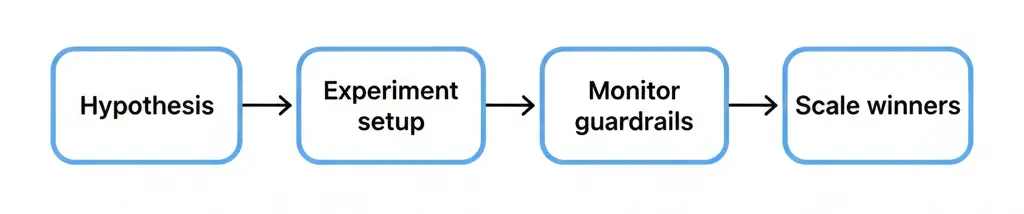
The right mindset is to treat Labs as an incubator, not a shortcut. You can explore it safely by ring‑fencing budget and using controlled experiments. Here is a practical framework that a paid search agency, ppc company, or in‑house team can follow:
1) Create a clear test plan
- Hypothesis: Write a one‑sentence statement that ties the Labs feature to a measurable outcome. Example: “Enabling the Labs ‘missed growth opportunities’ recommendations for Campaign A will increase conversions by 10 percent at stable CPA.”
- Primary KPI: Choose one north‑star metric. For lead gen this might be cost per lead or qualified lead rate. For ecommerce it might be ROAS or contribution margin per order.
- Guardrails: Define thresholds that trigger an auto‑stop. For example, “Pause if CPA increases by more than 20 percent for 7 consecutive days.”
2) Use the official Experiments workflow
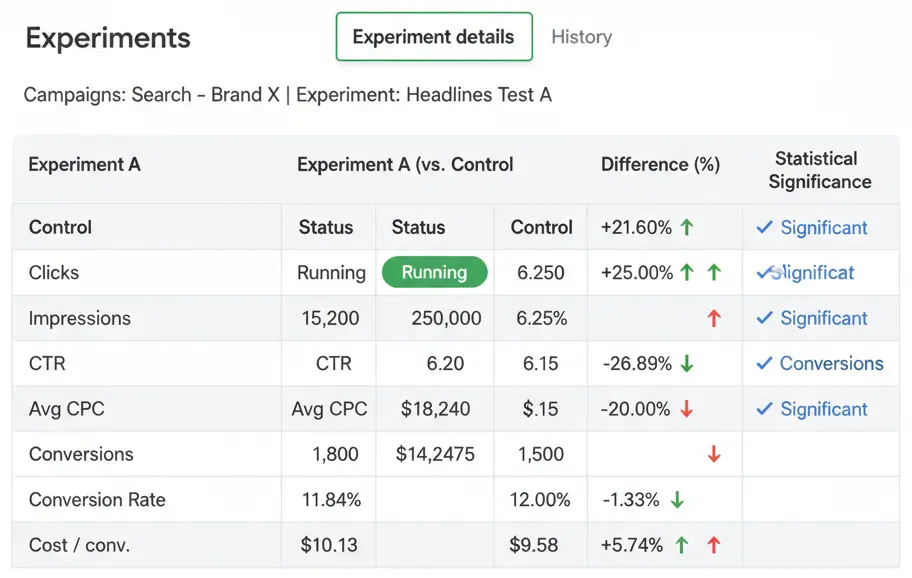
Set up a controlled test using Google Ads’ Experiments. Choose a traffic split or budget split, keep all other variables constant, and run long enough to reach significance. Google’s documentation details experiment setup and management for Search, Display, Video, Performance Max and more.
3) Allocate a separate test budget
- Carve out 5 to 10 percent of your monthly spend for Labs and other betas. Start smaller if your market is seasonal or volatile.
- Limit overlap. Avoid testing two Lab features in the same campaign at the same time unless the feature explicitly requires it.
- Always leave an unmodified control campaign or ad set to monitor background trends.
4) Measure lift vs. control
Track the deltas between experiment and control on your primary KPI as well as a shortlist of supporting metrics such as CTR, CVR, average CPC, impression share and search top impression share. Semrush has a helpful overview of the core PPC metrics worth monitoring regularly.
5) Decide quickly, then scale deliberately
- Winner: If the experiment shows a statistically and commercially meaningful improvement, apply to the original or replicate across similar campaigns in waves.
- Inconclusive: Iterate hypotheses or expand sample size. Do not “half adopt” an unproven feature broadly.
- Loser: Roll back promptly, capture learnings, and move the budget to the next idea in your pipeline.
Adopting a practical “beta mindset”
Copy shareable section linkAgencies and in‑house teams that thrive with Labs think like scientists, not gamblers. Here is how to operationalise that culture.
- Right-size your ambition: Set expectations that most experiments will not be long‑term keepers. You run them to learn. The minority that win will pay for the rest.
- One variable at a time: Confounded tests produce misleading signals. Change only what the Labs feature touches, then measure.
- Bias for documentation: Write a two‑page test brief before you start and a one‑page summary after you finish. Make decisions traceable.
- Portfolio thinking: Maintain a rolling backlog of 5 to 10 ideas, prioritised by expected impact and ease of implementation. Retire one, add one.
- Stakeholder alignment: Agree in advance on success criteria and guardrails with finance, sales and leadership so you are not debating them mid‑test.
Remember, Labs is a doorway to ideas. The Experiments page remains the rigor that turns ideas into outcomes.
Risk management when testing new platform features
Early adoption brings upside, but it also carries execution risk. A google ads agency or adwords agency should use the following safeguards.
Metrics to watch
- Primary efficiency: CPA or ROAS compared with control.
- Quality and incrementality: lead‑to‑opportunity rate, new‑customer rate, assisted conversions, branded vs non‑branded mix.
- Spend quality signals: search terms coverage, match type drift, geographic and device shifts, impression share loss due to rank/budget.
- Creative and query match: RSA asset performance breakdowns, landing‑page conversion rate.
Google’s experiment guidance reinforces running tests against a control and using consistent metrics to call a winner.
Common risks and remedies
- Seasonality interference: Run the test long enough to clear short‑term spikes, or use time‑based splits that alternate exposure evenly across weekdays and weekends.
- Budget cannibalisation: Protect your highest‑ROI campaigns with spend caps while the experiment runs.
- Misattribution: Ensure offline conversions and enhanced conversions are set correctly before switching on any Labs feature that optimises for down‑funnel events.
- Policy or brand safety surprises: Review new placements or automated asset usage, and monitor search term reports closely in the first 72 hours.
- Premature conclusions: Decide in advance what sample size and minimum detectable effect you need. If you cannot achieve that with your traffic, run the test longer or choose a higher‑volume campaign.
Early adopter vs wait‑and‑see
When to go early: you have strong measurement, a diversified account, and clear hypotheses. You benefit most when a feature aligns with known bottlenecks, such as capturing more incremental demand at a profitable ROAS.
When to wait: you lack reliable conversion tracking, are in peak season, or the feature materially alters bidding or creative in ways you cannot monitor yet.
What could show up in Labs, and how to test it
Copy shareable section linkBecause Labs is a dynamic hub, your exact options will vary. Reports so far mention items like missed growth opportunities. Here is how to test responsibly, using the official experiments workflow.
Example: “Missed growth opportunities”
- Identify candidate campaigns: choose stable Search or Performance Max campaigns with consistent conversion volume.
- Draft a hypothesis: “Enabling the recommendation on Campaign A will raise conversions by 10 percent at no more than 5 percent higher CPA.”
- Set up an experiment: clone the campaign, apply the Labs change to the experiment branch, split traffic 50 to 50, and run for two conversion cycles.
- Monitor guardrails: daily checks on CPA or ROAS, plus impression share and query quality.
- Decide: if successful and sustained, apply to the original or scale to similar campaigns in phases.
Governance for agencies and in‑house teams
Copy shareable section link
Testing is easier to manage when roles are clear. The following checklist suits any pay per click agency, ppc management agency or in‑house group.
- Ownership: assign a Labs owner to maintain the backlog, write briefs and run weekly stand‑ups.
- Documentation: store hypotheses, setups and outcomes in a shared log so wins replicate quickly across accounts.
- Finance alignment: agree on a persistent test budget and reporting cadence so experiments never starve or over‑consume.
- Client transparency: for agencies, show clients which tests are live, what the guardrails are, and when you will decide.
- End‑of‑test actions: only promote winners to business‑critical campaigns after they prove themselves on a pilot group.
Step‑by‑step: run a Labs test safely
- Audit access: log in and check whether Labs appears in your left‑hand navigation. If unavailable, monitor news sources until rollout expands.}
- Pick 1 to 2 features to try: prioritise the options that directly address your current bottleneck.
- Define KPI and timeline: choose one primary metric, set minimum detectable effect and test duration.
- Set up a formal experiment: build via the Google Ads Experiments page, using a clean split and consistent settings. :contentReference.
- Allocate a test budget: earmark 5 to 10 percent of monthly spend and set guardrails.
- Monitor for significance: track lift vs control on your KPI plus secondary diagnostics like CTR, CVR and CPC.
- Decide and document: promote winners, retire losers, write a short summary, and queue your next test.
Frequently asked questions
Copy shareable section linkIs Labs the same as the Experiments page?
No. Labs is an entry point for early features. Experiments is the built‑in framework for testing and is where you should validate any Labs feature before a full rollout.
What if I do not see Labs in my account?
Availability is limited during the test. Keep an eye on industry coverage and Google updates. In the meantime, use the Experiments page to test your own hypotheses with current features.}
What KPIs should I use?
Use a single primary KPI that matches your business model. For ecommerce, ROAS or profit per click. For lead gen, qualified lead rate or cost per qualified lead. Supplement with CTR, CVR and CPC to diagnose changes. Semrush offers a concise overview of the metrics that matter.
How long should tests run?
As long as it takes to achieve the sample size needed to detect your target effect with confidence. If volume is low, extend duration or test on higher‑traffic campaigns to reach significance.
How Doublespark can help
Copy shareable section linkIf you want an experienced partner to structure a safe, productive testing programme, our team can support every step, from hypothesis design and ppc management to analytics and stakeholder reporting.
- Explore our PPC management services for ongoing optimisation and strategic testing.
- Strengthen your tracking and attribution with our Google Analytics experts.
- If you need senior guidance on prioritising tests and aligning stakeholders, talk to our marketing and SEO consultancy.
Whether you are a growing UK brand or an enterprise advertiser, working with a seasoned pay per click agency can accelerate learning while protecting core performance.
External sources and further reading
Copy shareable section linkConclusion
Copy shareable section linkThe Labs hub in Google Ads is a welcome move toward transparency. It puts emerging capabilities where practitioners can actually find and try them. That does not mean you should flip switches and hope for the best. Treat Labs as your idea shelf, and use the Experiments page as your proving ground. With clear hypotheses, a dedicated test budget, and firm guardrails, your team can bank real wins while everyone else waits for the general rollout.
If you would like expert support to design your testing roadmap, optimise campaigns and build the analytics needed to make confident decisions, speak to our PPC management team or book a consultancy session. We are a UK paid search company that delivers pragmatic ppc services focused on results.