
In 2025, advertising campaigns need to do more than drive traffic - they must generate real business outcomes. Whether you're aiming for leads, sales, or sign-ups, your ads should bring you closer to your target customers and generate measurable returns. But how do you truly evaluate whether your campaign is delivering?
Google Ads (formerly AdWords) offers powerful conversion tracking tools to help you understand what’s working - and what isn’t. Your conversion rate is the metric to watch. It shows the percentage of users who complete a desired action after clicking your ad, such as making a purchase or filling out a form. According to recent industry data, the average Google Ads conversion rate across all industries sits around 2.35%, while top-performing campaigns can exceed 5% or more. On the lower end, conversion rates can dip below 1% - usually a sign that something in the funnel needs fixing.
Shockingly, over 40% of Google Ads accounts still don’t have conversion tracking properly set up. Without this data, advertisers are effectively flying blind - spending money without knowing what it’s achieving. To succeed, you need to track your campaigns rigorously and optimise every stage of the user journey.
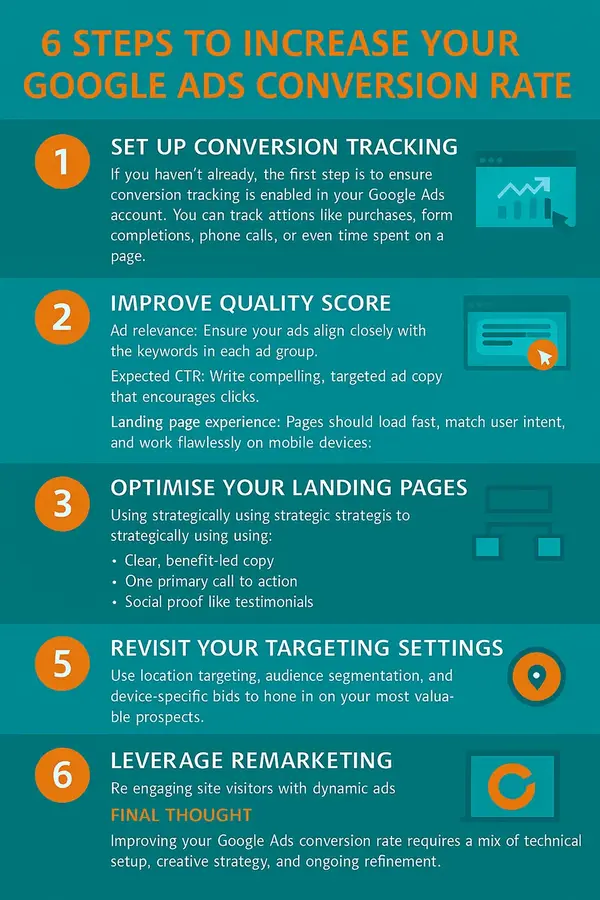
Step 1: Set Up Conversion Tracking
If you haven’t already, the first step is to ensure conversion tracking is enabled in your Google Ads account. You can track actions like purchases, form completions, phone calls, or even time spent on a page. This data enables you to measure ROI accurately and make data-driven decisions about budget allocation and campaign adjustments.
Step 2: Improve Quality Score
Your Google Ads Quality Score is one of the most important factors influencing the performance and cost-efficiency of your paid search campaigns. It determines how frequently your ads appear, how prominently they are displayed, and how much you pay each time someone clicks. In short, a high Quality Score can give you more visibility for less money – while a low score can make even well-funded campaigns underperform.
A higher Quality Score typically results in a lower cost-per-click (CPC), higher ad rankings, and better overall return on ad spend (ROAS). In today’s competitive PPC landscape, optimising for Quality Score is no longer optional – it’s essential. In 2024, Google continues to reward advertisers who provide a more relevant, engaging, and seamless user experience. That means refining three key elements:
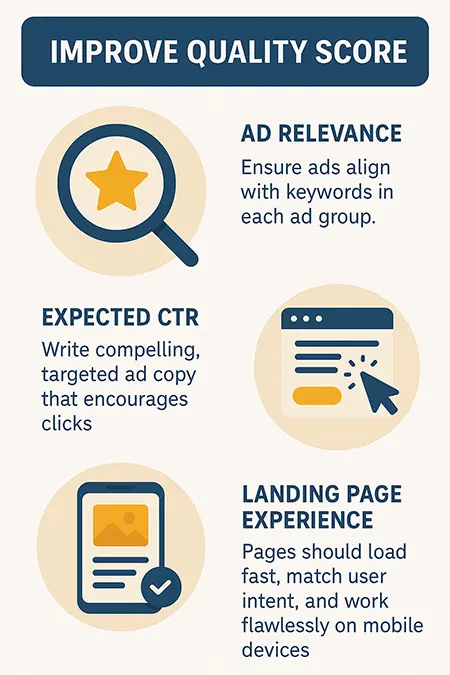
- Ad Relevance: Your ad copy must match the searcher’s intent and closely relate to the keywords in your ad group. Avoid generic messaging – instead, use tightly themed ad groups and tailor your copy to speak directly to the search query.
- Expected Click-Through Rate (CTR): Google uses historical data to estimate how likely users are to click your ads. Writing compelling, targeted ad copy with strong calls to action increases this likelihood and signals that your ads are valuable and engaging.
- Landing Page Experience: Once users click, they need to land on a page that loads quickly, meets their expectations, and functions seamlessly on all devices – especially mobile. The content should reflect your ad promise, and the path to conversion should be clear and frictionless.
Improving your Quality Score is not just about tweaking ads – it’s about aligning your entire campaign from keyword to click to conversion. Done properly, it enhances user satisfaction, increases conversions, and reduces wasted spend. Ultimately, it makes your entire PPC strategy more effective, sustainable, and profitable over time.
Step 3: Optimise Your Landing Pages
Getting the click is only half the battle. Once visitors arrive on your site, your landing page must convert. A high-converting landing page is visually clean, fast to load, and tailored to the user's search intent. Here's what to focus on:
- Clear, benefit-led copy that speaks to your audience's needs.
- One primary CTA (call to action) that stands out on the page.
- Consistent messaging between your ad and your page content.
- Social proof like testimonials or reviews to build trust.
- A/B testing to continually refine your layout, CTA, and messaging.
Tools like Google Optimize, VWO, or Hotjar can help you analyse and test landing page performance to improve outcomes over time.
Step 4: Refine Keyword Match Types
Keyword Match Types in Google Ads
Keyword match types in Google Ads give advertisers essential control over when their ads appear in search results. By defining how closely a user’s query must match your chosen keywords, you can significantly influence both campaign reach and quality of traffic. Using the right combination of Broad Match, Phrase Match, and Exact Match allows you to fine-tune your targeting strategy for both visibility and conversions.
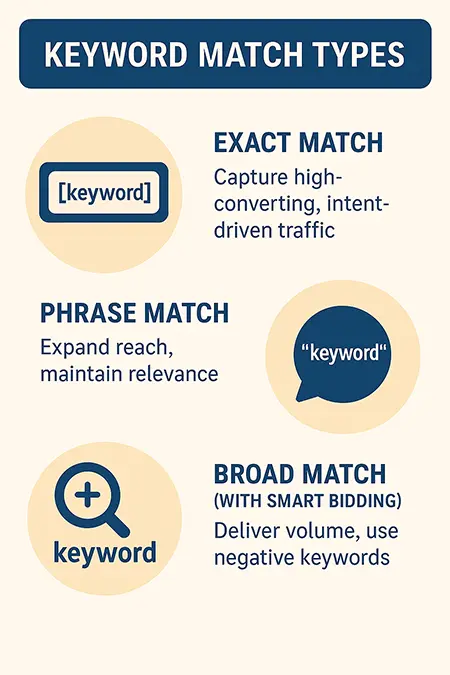
Exact Match
Exact Match is the most precise option and is ideal when you want to target users who are searching with clear intent. These users typically know exactly what they want and are more likely to convert. Use exact match for high-value keywords where precision matters – especially if budget efficiency is a priority.
Phrase Match
Phrase Match offers a middle ground. It gives you a wider audience than exact match but keeps a high degree of relevance. Your ad will show when a user’s query includes your keyword phrase in the same order, possibly with words before or after. This match type is ideal for discovering new variations of search queries while keeping targeting focused.
Broad Match (with Smart Bidding)
Broad Match provides the greatest reach but carries more risk if used incorrectly. With Smart Bidding enabled, it can be a powerful way to drive volume and uncover long-tail opportunities. However, without proper monitoring and negative keyword lists, it can also waste budget on irrelevant clicks. It’s essential to pair broad match with regular search term reviews and performance analysis.
To get the most from your campaigns, regularly review your search terms report. Look for search queries that drive strong results and consider assigning them to their own ad groups or campaigns. Continual refinement of your keyword match strategy ensures your ads reach the right users – at the right time and cost.
Step 5: Revisit Your Targeting Settings
Use location targeting, audience segmentation, and device-specific bids to hone in on your most valuable prospects. For example:
- Adjust bids higher for mobile users if they convert better.
- Exclude locations or times of day that underperform.
- Use in-market and affinity audiences to target users more likely to convert.
The more precisely you target your ads, the more efficient your budget becomes.
Step 6: Leverage Remarketing
Remarketing allows you to re-engage users who’ve already visited your site but didn’t convert. Since these users are already familiar with your brand, they’re more likely to convert on a second or third interaction. Use dynamic remarketing to serve tailored ads based on the products or pages they viewed. Platforms like Google Ads, Meta Ads, and LinkedIn all offer robust remarketing tools to help boost ROI.
Final Thought
Improving your Google Ads conversion rate in 2024 requires a mix of technical setup, creative strategy, and ongoing refinement. By focusing on data-driven decision-making and aligning ad content with user intent, you’ll see stronger ROI, lower costs, and more valuable leads. Don’t just aim for clicks — aim for outcomes.