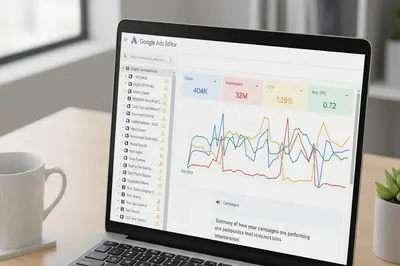
Peterborough Penalty Recovery & SEO Troubleshooting
Win back lost rankings, uncover the real cause of sudden traffic drops, and get your Peterborough website performing again with focused penalty recovery and hands-on SEO problem solving.
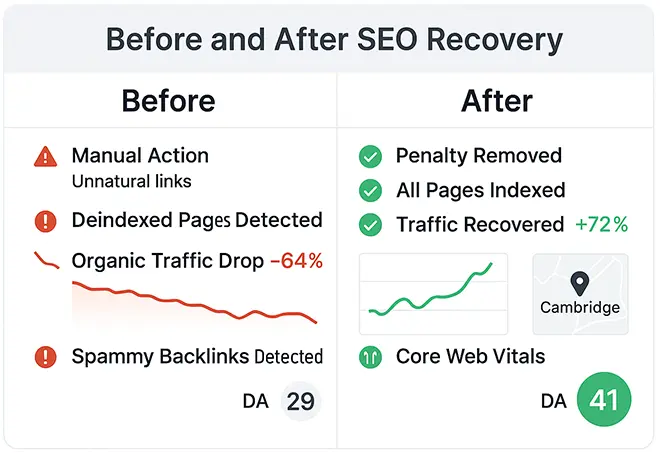
Win Back the Rankings and Enquiries You Lost
Tell us when your traffic dropped and what changed around that time, and we'll diagnose the real cause and set a prioritised plan to recover it. It's delivered by the same senior team behind our work as an SEO Company Peterborough, so your site comes back stronger and better protected against the next drop.
Explore Key Sections of This Page
What Is SEO Penalty Recovery & Troubleshooting?
Penalty recovery and SEO troubleshooting is the work of finding exactly why a Peterborough website has stopped performing in search, then fixing the underlying problems so visibility and traffic can return.
It is not the same as routine SEO tasks. Instead of simply adding new content or tweaking a few pages, the focus is on diagnosis, evidence-led root cause analysis, and remediation when something has gone wrong, whether that is a Google manual action, an algorithm shift, an indexing fault, or a technical change that has quietly undermined performance.
Our approach is built around recovery, but it also prioritises prevention - keeping your site aligned with search engine guidelines so you are far less likely to face the same drop again as your Peterborough visibility grows.
Common Problems We Fix
- Google manual actions – Penalties linked to unnatural links, cloaking, thin pages, doorway tactics, or other policy breaches
- Algorithm-related declines – Drops following major updates, including quality and helpfulness shifts, link evaluation changes, and core ranking refreshes
- Sharp traffic or ranking losses – Sudden changes that require investigation across Search Console, analytics, crawl data, and recent site edits
- Indexing and de-indexing problems – Pages falling out of the index due to canonical confusion, crawl traps, sitemap issues, or poor internal discovery
- Duplicate or low-value content – Pages that overlap heavily, add little unique value, or dilute topical authority across the site
- Toxic link profiles and negative SEO risks – Harmful inbound links or patterns that weaken trust and can trigger manual review
- Over-optimisation and manipulation signals – Unnatural anchor text, keyword-heavy templates, and on-page patterns that look engineered rather than useful
- Incorrect noindex and canonical setups – Tags that accidentally block key pages or split ranking signals across duplicates
- Redirect chains and loops – Redirect behaviour that wastes crawl budget, slows users down, and creates inconsistent indexation
- Soft 404s and crawl anomalies – Pages Google treats as low-value or broken, even when they return a 200 response
- Mobile usability and Core Web Vitals issues – Layout instability, slow interaction, responsiveness faults, and mobile-first indexing problems
- Site migration errors – Ranking losses caused by poor redirect mapping, changed URL structures, missing canonicals, or mis-handled launches
- Blocked resources and rendering issues – Critical CSS, JavaScript, images, or API endpoints that prevent Google from rendering pages properly
- Structured data issues – Manual actions or rich result losses triggered by misleading, incorrect, or inconsistent schema markup
- International targeting mistakes – Hreflang conflicts, duplicated regional pages, or incorrect country targeting that causes cannibalisation
Do not let penalties or persistent technical faults keep your Peterborough site stuck. With Doublespark’s penalty recovery and troubleshooting expertise, you can rebuild trust, restore search visibility, and move forward with a stronger, more reliable SEO foundation.
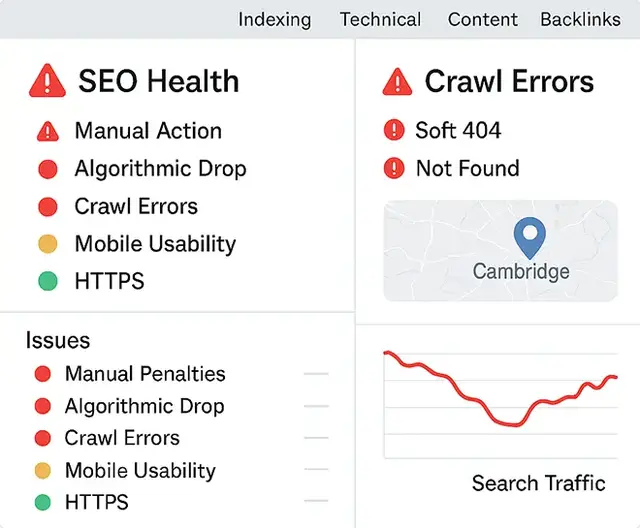
Why Penalty Recovery & SEO Troubleshooting Matters
When a Peterborough business relies on organic search, a sudden loss of visibility can undo months or even years of progress almost overnight.
Whether the trigger is a Google manual action or an algorithm shift that re-evaluates your site’s quality signals, the impact is rarely limited to rankings alone. It typically shows up quickly in enquiries, online sales, and the overall cost of acquiring new customers.
Our penalty recovery and SEO troubleshooting service is built to repair the damage, then strengthen the foundations so you are far less exposed to future volatility.
Penalty recovery is not a quick patch. It is a structured technical and strategic programme, because if the real cause is missed or only partially addressed, the same problem can return or gradually get worse.
What Can Happen When Issues Are Left Unresolved
- Significant ranking losses across commercial keywords and service pages
- Reduced organic traffic leading to fewer leads, calls, and quote requests
- Important pages being dropped from Google’s index due to quality or technical signals
- Lower trust in the domain which can make future growth slower and more expensive
- Increased pressure on paid media as ads are forced to fill the gap left by organic decline
“Getting hit by a Google penalty can feel like a digital disaster.”
With Doublespark, you get a clear recovery plan, practical implementation support, and long-term safeguards that help your Peterborough website regain visibility and stay on track.
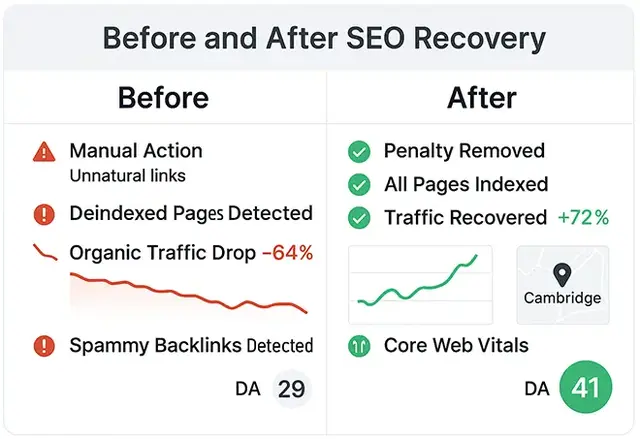
Our Penalty Recovery & Troubleshooting Services
Recovering from a Google penalty or an unexpected rankings collapse takes more than general SEO. Doublespark delivers a structured penalty recovery and troubleshooting service for Peterborough organisations that need answers, fixes, and a stronger foundation for long-term search performance.
We work from evidence, not assumptions. That means isolating what changed, proving why it changed, then applying the right corrective actions so your visibility can return and stay stable as Google continues to evolve.
Penalty Diagnosis and Forensic Audit
We start by confirming whether the issue is a manual action, an algorithm-driven reassessment, or a technical fault that is blocking crawling, indexing, or ranking. You get a clear timeline of when performance shifted, what areas were hit hardest, and which signals point to the root cause. This includes Search Console checks, index coverage reviews, content quality analysis, and a detailed assessment of link risk.
Manual Action Clean-Up and Reconsideration Support
If Google has applied a manual action, we identify the specific violations, fix them properly, and document the work in a way that satisfies Google’s reviewers. Where needed, we help assemble a reconsideration request that explains what was wrong, what has been corrected, and what safeguards are now in place to prevent repeat issues.
Algorithmic Drop Investigation
When visibility falls without a manual action, the cause is often a quality, relevance, or trust recalculation. We compare your performance changes against known update periods, then evaluate the areas most likely to be responsible, such as thin page sets, over-optimised templates, poor internal linking, weak intent match, or link profile signals. From there, we create a targeted recovery plan built around what will move the needle for your Peterborough pages.
Link Risk Review, Removals, and Disavow Management
If backlinks are a contributing factor, we separate safe links from risky ones, identify patterns that can trigger distrust, and support removals where that is feasible. Where appropriate, we prepare a disavow file that is conservative, well-justified, and designed to reduce risk without accidentally discarding valuable authority.
Duplicate and Low-Value Content Fixes
Many ranking drops are linked to pages that overlap, add little unique value, or dilute topical focus. We locate underperforming or repeated content, then recommend the right treatment for each area, including consolidation, rewrites, stronger internal linking, canonical alignment, and noindex where pages serve a user purpose but should not compete in search.
Technical SEO Troubleshooting
We resolve the issues that stop Google from crawling and understanding your site properly. That includes redirect chains and loops, broken internal links, inconsistent canonical tags, blocked resources, mobile usability problems, Core Web Vitals concerns, and structural issues that make key pages hard to discover. The goal is to remove friction for both crawlers and users.
Indexation and Crawl Control
We audit and correct your indexation signals so Google focuses on the pages that matter for your Peterborough visibility. This covers robots.txt and meta robots checks, sitemap accuracy, parameter handling, canonical conflicts, internal duplication, and crawl budget waste caused by unnecessary URLs.
Documentation and Evidence Packs
For manual actions and complex recovery projects, we provide clear documentation of what was found, what was changed, and what monitoring has been implemented. This is useful for internal stakeholders, developers, and any future audits, as well as supporting reconsideration where relevant.
Post-Recovery Monitoring and Reinforcement
Recovery does not end when rankings begin to return. We continue to track visibility, crawl behaviour, index coverage, and key page performance, then reinforce improvements with regular checks so small issues do not become the next major drop.
Every penalty or sudden decline has its own fingerprints, which is why we avoid one-size-fits-all playbooks. Your recovery plan is built around the specific realities of your site, your market, and your Peterborough search targets.
With Doublespark, you get a methodical approach, implementation-focused guidance, and ongoing safeguards designed to protect your hard-won visibility.
If you are dealing with a manual action, an algorithm impact, or an unexplained traffic fall, we can help you regain stability and build a stronger platform for sustainable growth.
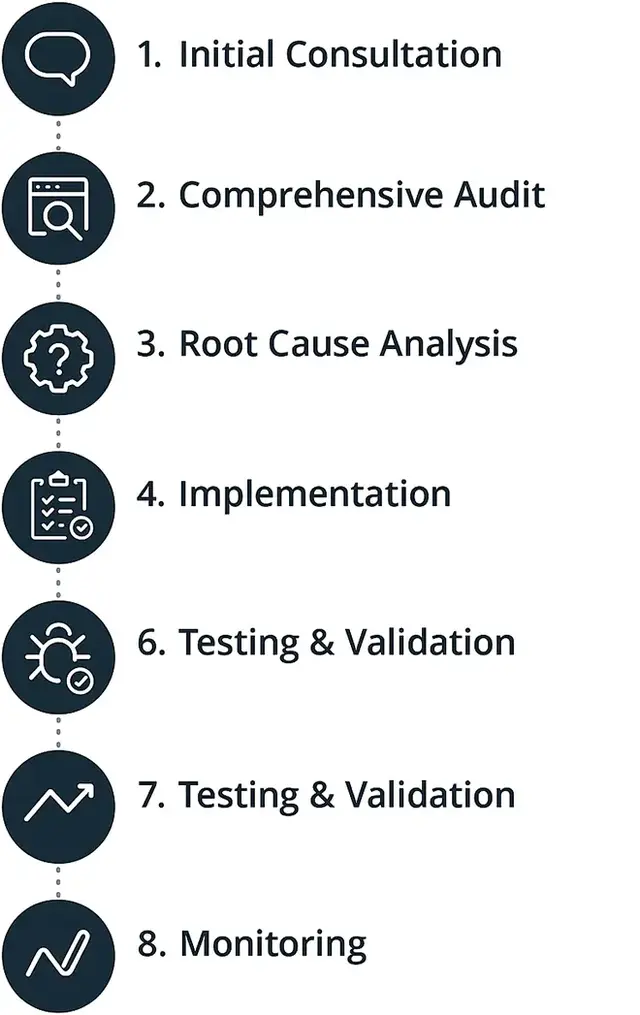
Our Penalty Recovery & SEO Troubleshooting Process
Reliable SEO recovery starts with a defined process you can trust.
When a Peterborough website loses rankings, the cause is rarely obvious at first glance. That is why Doublespark uses a structured troubleshooting framework that pinpoints what has changed, proves what is driving the decline, and applies fixes in the right order, whether the problem is technical, content-led, or linked to a penalty.
By working methodically, we avoid guesswork, prevent wasted effort, and make sure the actions taken actually move the site back towards stable search visibility.
Below is how we take a problematic website and turn it into a stronger, cleaner, penalty-resistant asset.
- Discovery and Context Gathering
We begin with a focused call to understand what you have noticed, when the decline started, and what changed around that time. For Peterborough businesses, this also includes clarifying which services, locations, and pages matter most commercially so the recovery work is aligned to revenue, not just rankings. - Full Site Investigation
We review the site from multiple angles, combining Search Console insights with crawling, backlink evaluation, and server-level evidence where available. This includes technical checks, index coverage, templates, internal linking patterns, content quality signals, and log file analysis to see how search bots are actually interacting with your site. - Pinpointing the True Cause
Next, we separate symptoms from causes. We confirm whether the problem is driven by a manual action, an algorithm re-evaluation, or issues such as crawling blocks, canonical conflicts, redirects, or widespread content overlap. Where multiple issues exist, we map how they relate, so the recovery plan fixes the real blockers first. - Prioritised Recovery Blueprint
You receive a clear action plan ordered by impact and urgency. This includes what to fix first, what can be staged, what should be monitored, and what changes must be made carefully to avoid collateral losses. Timelines and responsibilities are set out so your team knows exactly what is happening and why. - Delivery and Fix Implementation
We either implement the work directly or collaborate closely with your developer and content teams to apply changes correctly. This stage may involve technical repairs, content consolidation, link risk handling, schema clean-up, and indexation control, depending on what the investigation uncovers. - Verification and Quality Checks
Every major change is tested. We re-crawl affected areas, validate redirects and canonicals, confirm indexation signals, and review Search Console feedback to ensure Google is receiving the right instructions. The aim is to confirm that fixes are real, not theoretical. - Ongoing Monitoring and Reinforcement
Recovery is tracked over time through visibility, indexing behaviour, and error signals. We watch for improvement patterns and potential regressions, then reinforce the work with follow-up checks so the site does not slip back into the same conditions that caused the drop.
This end-to-end process is designed to resolve complex SEO problems completely and reduce the risk of repeat penalties or performance drops for Peterborough websites.
Recent Results
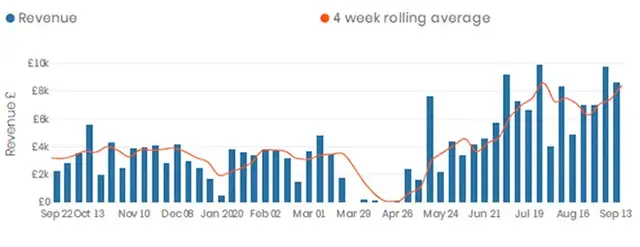
Our penalty recovery and SEO troubleshooting work in Peterborough is built around practical fixes and measurable outcomes, helping businesses rebound from penalties, algorithm shifts, and technical SEO faults that hold back growth.
Client: Peterborough-Based Ecommerce Retailer
Problem: Major visibility loss after an algorithm update, driven by duplicated category copy and low-value filter pages competing in search.
Solution: Full category audit, consolidation of overlapping pages, improved internal linking, and a complete rewrite programme focused on intent-led category content.
Result: 61% uplift in organic sessions within 12 weeks, with multiple priority categories returning to page one for high-intent product searches.
Client: UK-Wide B2B Provider with a Peterborough Office
Problem: Manual action triggered by historic link building, including manipulated anchors and low-quality directory placements from a previous supplier.
Solution: Backlink risk assessment, link removal outreach, curated disavow submission, and a structured reconsideration pack documenting corrective steps and safeguards.
Result: Manual action removed in 26 days, with organic enquiries returning steadily and performance back at pre-penalty levels within a quarter.
Client: Local Trades Firm – Peterborough
Problem: Pages dropped from Google after a site rebuild, caused by conflicting canonicals, broken redirect mapping, and an incomplete sitemap structure.
Solution: Redirect and canonical clean-up, sitemap rebuild, indexation signal corrections, and crawl validation to ensure Google could reliably discover and trust key service pages.
Result: Core pages re-indexed within 5 weeks, rankings stabilised shortly after, and lead volume increased by 32% compared to the period before the rebuild.
If your Peterborough website has lost rankings, traffic, or visibility, our SEO troubleshooting specialists can identify the cause, implement the right fixes, and put protections in place so your recovery lasts.
Tools & Technology We Use For Penalty Recovery & Troubleshooting
At Doublespark, we use a proven set of professional SEO tools to diagnose and fix the issues that cause ranking losses, penalties, and persistent technical problems for Peterborough websites.
Tools matter, but the real value comes from how the data is interpreted. We combine multiple data sources to confirm what Google is seeing, what users are experiencing, and what has changed across your site and your backlink profile, then we use that evidence to guide the recovery work.
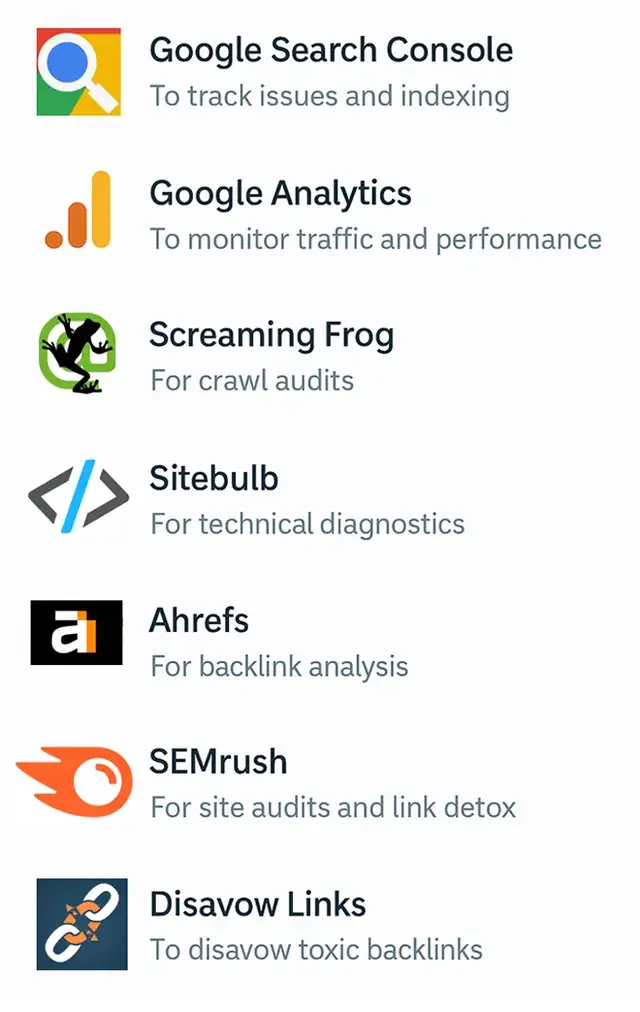
Google Search Console and Google Analytics
Used to understand index coverage, crawling behaviour, manual action signals, and performance trends. We look for the timing and pattern of traffic drops, query and page-level changes, and the warning signs that point to a specific type of issue.
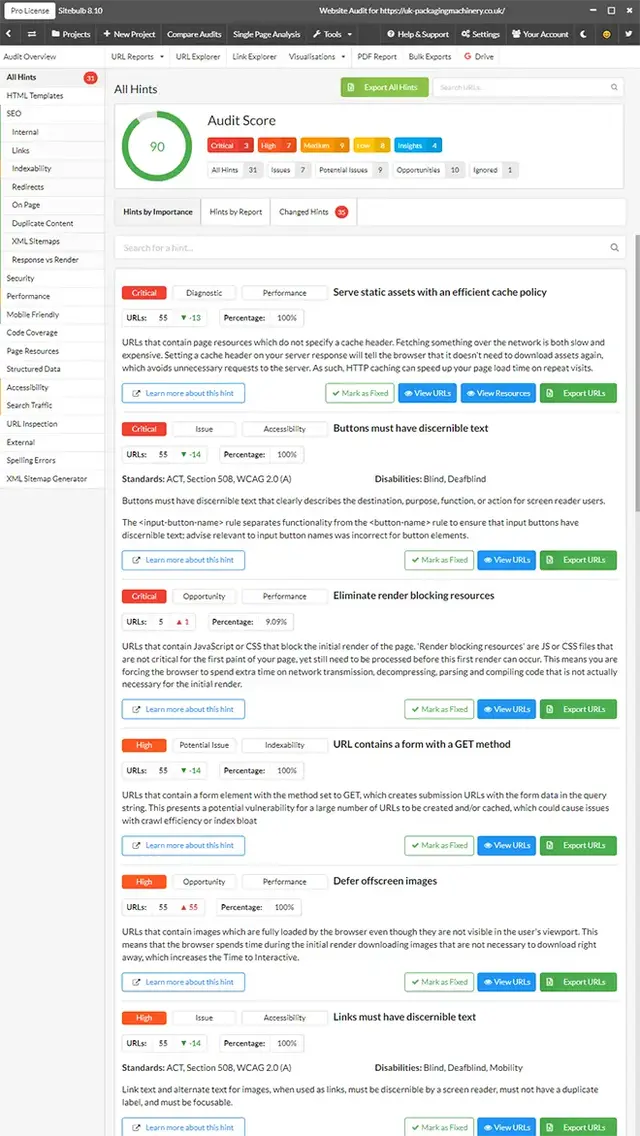
Screaming Frog and Sitebulb
For deep crawls that expose technical faults and structural problems, including redirect chains, canonical conflicts, duplicate content clusters, thin page sets, internal linking gaps, orphaned URLs, and templates that generate low-value pages at scale.
Ahrefs, Semrush, and Majestic
For link analysis that goes beyond surface metrics. We identify risky link patterns, anchor text manipulation, unnatural placements, and low-trust sources, then map link risk against ranking and visibility shifts to build an informed remediation plan.
PageSpeed Insights and Lighthouse
To pinpoint performance issues that can reduce crawl efficiency and harm user experience, including slow rendering, heavy scripts, mobile problems, and Core Web Vitals signals that undermine your Peterborough pages in competitive searches.
Google’s Spam Policies
We use Google’s published guidance as the compliance benchmark, ensuring fixes are aligned with what Google expects and reducing the likelihood of repeated penalties after recovery work is completed.
Google Disavow Tool
Where link risk is a genuine factor, we build carefully considered disavow files to neutralise harmful backlinks without weakening legitimate authority, supporting safer long-term recovery.
Manual Actions Reporting
We track manual action status, affected sections, and progress signals throughout the clean-up and reconsideration stages, ensuring the recovery work stays aligned with the specific issue Google has flagged.
With Doublespark’s experience and diagnostic toolkit, we turn uncertainty into a clear plan of action, restore performance to Peterborough websites, and reinforce the SEO foundations that protect growth over the long term.
Industries We Support
When a Peterborough website loses rankings or attracts a penalty, you need evidence and expertise, not trial and error. Our SEO troubleshooting and penalty recovery service is designed to identify the cause quickly, apply the right fixes, and rebuild stability so your visibility can return and stay protected.
Whether you are dealing with a manual action, an algorithm-driven drop, pages slipping out of the index, or a sudden fall in traffic after a rebuild or migration, we use forensic auditing and hands-on implementation to isolate what changed and why. That means reviewing Search Console signals, crawl behaviour, indexation patterns, content quality, internal linking, and backlink risk to find the real driver behind the decline.
Once the cause is confirmed, we focus on practical recovery actions that remove the blockers and restore trust. This can include cleaning up harmful links, correcting crawl and indexation issues, repairing technical misconfigurations, consolidating or improving low-value content, and refining site structure so Google can understand and prioritise the pages that matter most for your Peterborough visibility. The result is a recovery plan that fixes today’s problem and strengthens your site against the next disruption.
-
Professional Services
-
Local Trades & Services
-
SaaS & Technology Providers
-
Hospitality & Leisure
-
Legal & Financial Services
-
Franchise Businesses
-
Construction & Skilled Trades
-
Logistics & Transport
-
Manufacturing & Industrial
-
Travel, Tourism & Attractions
-
Property & Real Estate
-
App & Software Developers
Penalty Recovery Services for Peterborough Businesses
Across Peterborough’s growing business community, from fast-moving independents to established companies, we’ve helped local organisations recover from SEO setbacks, penalties, and technical problems that limit visibility.
Whether you are serving customers around the city centre, supporting homeowners across areas like Werrington and Hampton, or selling further afield from a Peterborough base, our recovery work is tailored to how local search actually behaves in your market.
- Strengthened local landing pages and technical foundations to improve crawling, indexation, and ranking stability
- Refined content structure and on-page signals so service pages read clearly for users and make sense to search engines
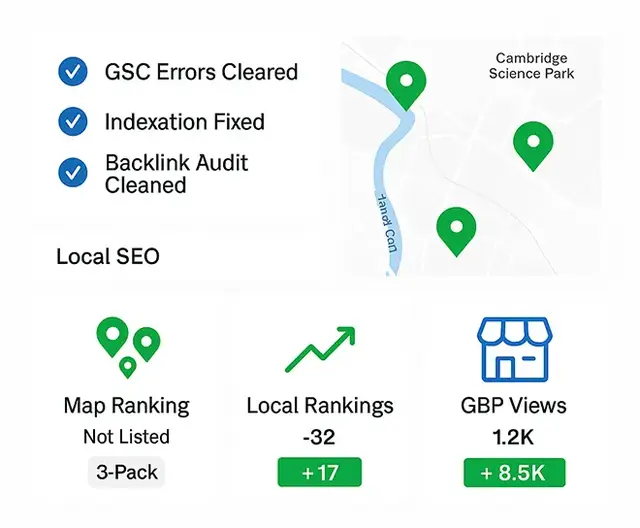
- Recovered visibility in local results, including map listings and location-based organic searches
- Corrected local schema issues and inconsistent business details across your site and key listings
- Restored rankings after site migrations, redesigns, CMS changes, or URL restructures
- Resolved duplication across multiple location and service pages that causes cannibalisation and weakens relevance
- Audited and cleaned up low-quality local backlinks and citation sources that can suppress performance
- Fixed canonical and indexation misconfigurations that hide important Peterborough pages from search
- Repaired broken business listings, citations, and inconsistent data across key platforms
- Connected Google Business Profile with on-site signals and structured data to support richer local visibility
By combining penalty recovery expertise with practical local SEO insight, Peterborough businesses can recover faster and build more dependable rankings, even when the issue is complex.
We bring technical accuracy and local understanding together to put your Peterborough presence back on course and performing strongly again.
Benefits of Penalty Recovery & SEO Troubleshooting
Fixing penalties and untangling stubborn SEO problems does more than bring lost traffic back – it improves the strength and reliability of your Peterborough website for the long term.
Our penalty recovery and SEO troubleshooting service is designed to restore rankings, but also to reduce future risk by bringing your site into line with current best practice and the way Google evaluates quality, trust, and usability.
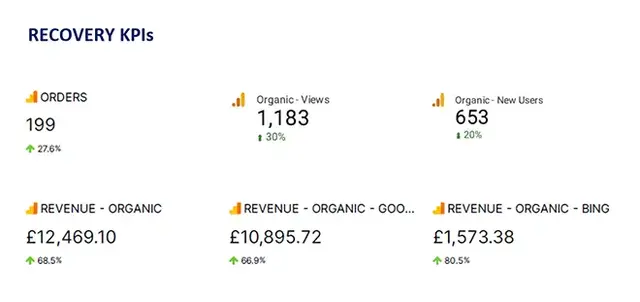
- Return of Search Visibility: Correcting penalties and technical blockers helps important pages appear and compete properly in Google again
- Organic Traffic Rebound: As visibility improves, visits recover for high-intent searches, including key Peterborough service and local terms
- Stronger Alignment With Google Guidance: A compliance-led clean-up reduces the likelihood of repeat penalties and trust issues
- Higher Technical and Content Standards: Root causes like duplication, crawl waste, thin pages, and poor internal structure are addressed at source
- Less Exposure to Algorithm Shifts: A cleaner site with clearer quality signals is typically more resilient when updates roll out
- More Durable SEO Performance: With weak areas fixed properly, ongoing SEO work builds on stable ground rather than fighting hidden problems
- Improved User Experience: Faster pages, better navigation, and clearer content structure often follow recovery work, supporting higher engagement and conversion
If your Peterborough site has suffered a major drop, or you simply feel something is limiting performance, our penalty recovery and troubleshooting service helps you reset, recover, and move forward with a stronger SEO foundation.
Why Choose Doublespark for Penalty Recovey & SEO Troubleshooting?
If your website has been hit by a Google penalty or has suddenly slipped down the rankings, you need a specialist who knows how to diagnose the cause and deliver a proper recovery.
Here is why organisations in Peterborough and the surrounding area choose Doublespark for penalty recovery and SEO troubleshooting:
- Experience that counts: We have supported businesses since 2005, including complex recoveries where visibility has dropped sharply.
- Recovery work that lasts: We have helped websites bounce back from major algorithm shifts and penalty scenarios, then stabilise performance over time.
- Advanced diagnostics: We combine Google Search Console, Ahrefs, Screaming Frog and other specialist tools to uncover issues that are easy to miss.
- Peterborough relevance: We understand how local intent works for Peterborough searches, from service pages to map visibility and location-driven enquiries.
- Site-specific solutions: No templates, no shortcuts. Each plan is built around the exact signals, faults, and risks present on your website.
"After a drop that wiped out our visibility in Google, Doublespark mapped out the causes clearly and helped us recover much faster than we expected. Highly recommended." - Client in Peterborough
If you are dealing with a penalty, an algorithm hit, or an unexplained rankings drop, Doublespark can provide the expertise, process, and implementation support needed to restore visibility and keep your SEO performance stable long term.

What Our Clients Are Saying
5-Star Google Reviews That Reflect Our Commitment to Excellence
-
2 months ago
I have been with Doublespark since 2012. As a Cambridge SEO company they supported the online shop and the online marketing, helping more clients find and book our services. Gary has always been willing to help with any issues on the website and has been quick to respond when I have asked for any updates or changes to be made to the website. Highly Recommended
-
4 months ago
Great company to work with, on hand with tech queries and very proactive when an very rare issue arises.
-
6 months ago
Doublespark have looked after website maintenance and hosting for osteolabs since 2021. They keep the site running smoothly, deal with updates behind the scenes, and respond quickly whenever we need support.
-
8 months ago
most excellent people - helpful, knowledgeable and efficient.
-
9 months ago
Gary and the team at Doublespark are brilliant, we've worked together on a lot of very different digital marketing projects over a good many years. Always good results, always a good experience.


SEO Insights: Strategies, Trends and Tactics to Boost Organic Visibility

10 Search Strategies From BrightonSEO 2026
Ten things we brought back from brightonSEO 2026, from AI citation share to the conversion basics that still pay.

Optimising for Generative AI & Answer Engines
Discover how to optimise your SEO for AI Overviews and answer engines. Learn to adapt your content for generative results, build topical authority, and keep your brand visible in Google’s evolving search experience.
FAQs About Our Penalty Recovery & SEO Troubleshooting Services
What Does a Google SEO Penalty Look Like and How Can I Tell If My Site Has Been Affected?
An SEO penalty is when a website loses visibility because it has crossed a line with Google’s guidelines, or because Google’s systems have reassessed the site and decided it is less trustworthy, less helpful, or less relevant than before. For businesses in Peterborough, that can show up as fewer enquiries, fewer calls, and a sudden drop in the pages that normally bring in work.
There are two broad scenarios. A manual action is applied by a human reviewer after Google believes something on the site, or in the link profile, is deliberately manipulating results. An algorithm-led drop happens when an update changes how Google evaluates quality, links, or intent match and your site no longer meets the bar in the same way. Both lead to the same outcome, less search presence, less traffic, and fewer opportunities.
The tricky part is that a penalty is not the only thing that can cause a downturn. A platform change, a robots.txt mistake, a misused noindex tag, broken redirects, or even a tracking issue can produce similar symptoms. That is why the first step is always to confirm what is actually happening before any fix is attempted.
Common Signs Your Site Has Been Hit
- A steep decline in organic sessions that does not match normal seasonality
- Core service pages dropping for high intent searches, including Peterborough terms
- Branded rankings slipping, even when people search your business name directly
- Key URLs disappearing from results or showing as not indexed
- A notification inside Google Search Console that points to a specific issue
- Search results showing the wrong pages, or fewer pages, than you would expect
How We Confirm What’s Going On
At Doublespark, we treat this like an investigation. We check Google Search Console for manual actions, indexing changes, crawl behaviour, and page level performance shifts. We compare those signals against analytics, historical ranking patterns, and recent site changes like releases, migrations, template edits, and plugin updates. If backlinks are a risk factor, we review the link profile to spot obvious manipulation patterns, sudden spikes, or legacy link building that has aged badly.
Where needed, we also use crawl data and log evidence to see whether Googlebot is reaching the right pages, whether important resources are blocked, and whether technical signals like canonicals and redirects are sending mixed instructions. This allows us to separate cause from coincidence and avoid fixing the wrong thing.
If you have seen a significant drop, speed matters. The sooner the cause is identified, the fewer secondary problems you tend to accumulate, such as index bloat, content cannibalisation, or link trust loss.
Ignoring a penalty or a penalty-like issue can create long-term damage that becomes harder and more expensive to undo.
How Long Does SEO Penalty Recovery Usually Take for a Peterborough Website?
Recovery timelines vary because not all penalties and ranking drops are the same. Some sites have a single, clear fault that can be corrected quickly. Others have a mix of issues that have built up over time, such as thin content, messy indexation, and a risky backlink profile. The time it takes to recover depends on what caused the decline, how widespread it is, and how efficiently the fixes are implemented.
Manual actions typically involve two stages. First, the problems have to be corrected properly. Second, Google has to review the work and agree that the site is now compliant. That extra review step means manual action recovery often takes longer than algorithm-led issues, especially if link clean-up or content work is substantial.
Manual Actions vs Algorithm-Led Drops
With manual actions, you will usually see a message in Google Search Console describing the type of violation. Once fixes are completed, a reconsideration request is submitted. Google’s review can take weeks, and if the request is rejected, further work is needed before trying again. Each cycle adds time, so the goal is to get the clean-up right the first time.
With algorithm-led drops, there is no reconsideration form. Recovery depends on Google re-crawling the site, reprocessing changes, and then re-evaluating it over time. That can happen steadily, or in waves, particularly around larger updates. In practice, you may see early green shoots, followed by a slower climb as the improvements prove themselves.
What Has the Biggest Influence on Speed
- How widespread the issues are, for example sitewide thin pages or duplicated location content
- How quickly technical fixes can be deployed and verified
- Whether link risk requires outreach, removals, and careful disavow work
- How much content needs to be improved to meet current quality expectations
- How strong the site’s trust signals are before the drop happened
- How fast Google re-crawls your important pages after changes go live
For many businesses, meaningful recovery signals often appear within one to three months once the correct fixes are in place. Manual actions can take longer if the underlying breach is extensive. Algorithm-led recoveries can also take time if the site needs a deeper overhaul, for example consolidating pages, improving intent match, and strengthening internal linking.
In Peterborough markets, there is an extra consideration, competition. If competitors have improved while your site has been suppressed, regaining old positions may require not only fixing the problem, but also improving what the site offers.
Starting sooner usually shortens recovery time because you stop the problem from compounding.
What Are Google Manual Actions and What Does It Take to Remove One?
A manual action is a direct intervention by Google when a human reviewer concludes that a website has breached Google’s spam policies. This is different from algorithmic re-evaluation because it is not just a scoring change, it is an explicit penalty applied to parts of a site, or sometimes the whole domain.
For a Peterborough business, manual actions often arrive as a surprise because the causes can be historic. It might be link building done years ago, outsourced content that was rushed, or technical behaviour that looks like cloaking or deception. The key is that Google believes the site has taken steps to manipulate results or provide poor experiences at scale.
Typical Reasons Manual Actions Are Applied
- Unnatural links pointing to your site, or links from your site that pass value artificially
- Automatically generated pages with little original value
- Cloaking, sneaky redirects, or showing different content to users and crawlers
- Spammy structured data designed to mislead rich results
- User-generated spam, hacked pages, or injected content
How We Remove a Manual Action
First, we confirm the scope and reason inside Google Search Console. Google’s message usually points to the category of issue, but it rarely tells you exactly where every problem sits. Our job is to locate the offending patterns, quantify them, and then remove or correct them in a way that clearly aligns with policy.
If links are involved, we perform a risk-led link audit, identify manipulative patterns, and pursue removals where possible. If content quality is the issue, we remove, merge, or rebuild pages that do not meet standards, especially large clusters of thin pages that drag down trust. If the problem is technical, such as sneaky redirects or hacked content, the fixes need to be decisive, verifiable, and properly secured.
Once the clean-up is complete, we compile evidence of the work. The reconsideration request needs to be clear and honest, outlining what caused the issue, what steps were taken to fix it, and what controls have been put in place to prevent a repeat. Vague promises do not work. Google wants specifics and proof.
After submission, Google reviews the request. If it is accepted, the manual action is lifted and recovery can begin. If it is rejected, we revisit the findings, identify what remains, and repeat the process with stronger evidence and deeper clean-up.
Manual action recovery only works when the underlying breaches are removed thoroughly and documented clearly.
What Is an Algorithm-Driven Ranking Drop and How Is It Different From a Manual Penalty?
An algorithm-driven drop is when Google’s systems reassess your site and reduce its visibility without a manual reviewer applying a penalty. People often call this an algorithmic penalty, but in most cases it is a re-ranking event rather than an explicit punishment. The end result can look the same, traffic and rankings fall, but the mechanics are different.
For Peterborough websites, these drops often follow broad changes in how Google measures helpfulness, intent match, trust, and overall site quality. If a site has grown quickly with repeated templates, overlapping service pages, or thin content added to chase long-tail searches, an update can expose those weaknesses.
Update Types That Commonly Trigger Declines
- Content quality systems that reduce visibility for thin or repetitive pages
- Link evaluation systems that discount manipulative link signals
- Core updates that adjust how Google weighs trust, relevance, and usability
- Helpfulness-focused changes that reward user-first content over search-first pages
How We Approach Algorithm-Led Recovery
Because there is no manual action message, the work starts with mapping timing and impact. We analyse which sections dropped, which queries were affected, and whether the change was sitewide or isolated. We also review what changed on your side, such as a redesign, a content push, new navigation, or a batch of page launches targeting multiple nearby locations.
Next, we look for the quality gaps that updates typically expose. That can include duplicated content across service and location pages, weak intent alignment, missing supporting information, poor internal linking, and thin pages that exist mainly to capture keywords. We also assess whether the site has become bloated with low value URLs, such as filter pages, tags, parameters, and internal search results that compete with core pages.
Recovery actions are then designed to strengthen the site where it is weakest. This might involve rewriting or consolidating content, pruning low value pages, improving site structure, reducing index clutter, and tightening technical signals like canonicals and internal links. If backlinks are contributing, we address link risk and rebalance authority towards the pages that matter most.
Unlike manual actions, you do not apply for reinstatement. Once improvements are live, Google needs time to crawl and reassess. That is why algorithm recovery is both corrective and strategic, you are rebuilding the site so it naturally earns its way back.
Making your site resilient to algorithm changes is best treated as an ongoing programme, not a one-off fix.
Can Toxic Backlinks Damage My Google Rankings?
Spammy backlinks can harm performance, particularly when they form patterns that suggest manipulation. While Google has become better at ignoring low quality links, there are still scenarios where a backlink profile can contribute to suppressed visibility or trigger a manual action. For Peterborough businesses that inherited links from previous agencies, this is a common risk, the site is judged on what exists now, not on who built it.
Toxic links are not just links from obscure sites. The bigger issue is intent and pattern. Large volumes of paid placements, keyword-stuffed anchors, obvious private blog networks, and repeated directory submissions can send the wrong signals. Even if those links once helped, they can become liabilities when Google tightens enforcement.
How Harmful Links Can Affect SEO
Bad links can cause problems in two ways. First, they can contribute to a manual action if Google believes the site is involved in link schemes. Second, they can reduce trust algorithmically, meaning your pages struggle to compete even if the content is strong. In practice, businesses often see this as stubborn rankings that will not return, or as drops that align with link evaluation changes.
Negative SEO is also a concern, where someone points junk links at a domain to cause disruption. It is less common than people fear, but it does happen. The response is the same, assess the link profile calmly, separate noise from genuine risk, and act only where it is justified.
How We Clean Up Link Risk
- Review inbound links across multiple datasets to avoid blind spots
- Identify patterns that suggest manipulation, not just low quality appearance
- Prioritise actions based on risk and the likelihood of genuine impact
- Pursue removals where links are clearly harmful and reachable
- Create a careful disavow file when it is the right tool for the scenario
Disavow is not a routine step and it should never be used as a panic button. Done badly, it can remove legitimate authority. Done properly, it can reduce risk and support recovery, especially where a manual action is in play or where link patterns are clearly manipulative.
For many Peterborough sites, the best defence is ongoing monitoring. That means spotting new link spikes early, reviewing anchors periodically, and ensuring any active promotion work focuses on relevance and real brand value rather than shortcuts.
Leaving obvious link manipulation in place can keep a site suppressed even after other fixes are completed.
How Does Content Quality Influence Penalties and Ranking Drops?
Content quality is one of the most common reasons sites lose visibility, especially after major updates. Google’s goal is to rank pages that satisfy real users, not pages that exist mainly to capture keywords. If your site has thin, repetitive, or outdated content, it may not be penalised in the traditional sense, but it can still be held back by quality systems that reduce trust and relevance.
This is particularly important for Peterborough businesses with multiple service and location pages. If those pages read like minor variations of the same text, they can compete with each other, dilute topical strength, and send a signal that the site is producing content for search engines rather than customers.
Common Content Problems That Trigger Declines
- Pages that are too short to answer the query properly
- Duplicated copy across services, categories, or locations
- Automatically produced text that adds little practical value
- Outdated advice, thin FAQs, and pages that no longer match user intent
- Poor structure that makes content hard to scan and hard to trust
What We Do During Recovery
We start with a content inventory, mapping what exists, what performs, and what overlaps. Then we decide the right treatment for each area. Some pages need strengthening with clearer intent match, richer detail, and better internal support. Others need consolidation, where two or three weak pages become one strong page. In some cases, the best move is to remove or noindex content that is not helping users or search performance.
We also focus on consistency across the site. Strong content is not only about word count, it is about clarity, usefulness, and credibility. That means explaining services properly, setting expectations, adding proof points, and ensuring pages reflect how customers in Peterborough actually search and decide. When done well, content improvements also tend to boost conversion rate because users understand what you do and why they should choose you.
Content work is often the difference between partial recovery and full recovery. If the site is only technically repaired but the content still lacks depth or uniqueness, rankings may not return as expected.
Investing in genuinely helpful, original content is one of the strongest long-term defences against ranking volatility.
Can Technical SEO Problems Cause Penalty-Like Drops?
Most penalties are linked to spam policy breaches, but technical issues can absolutely cause ranking losses that look like a penalty. If Google cannot crawl, render, or index your important pages reliably, visibility can fall fast. For a Peterborough business, this often happens after a site rebuild, a CMS migration, or a well-meaning change to templates that accidentally alters crawl and index signals across hundreds of URLs.
Technical issues can also compound other problems. If you have weak content and technical friction, Google has even less reason to keep the site visible. That is why technical troubleshooting is a core part of any recovery project.
Technical Issues That Commonly Damage Visibility
- Noindex tags applied to key pages by mistake
- Canonical tags pointing to the wrong URLs or changing unpredictably
- Broken internal links that prevent discovery of important content
- Redirect chains and loops that waste crawl capacity
- Slow page speed and weak Core Web Vitals that reduce usability
- Robots.txt rules blocking resources needed for rendering
- Mobile usability errors that harm mobile-first indexing performance
How We Diagnose and Fix Technical Causes
We combine crawl diagnostics, Search Console reports, and where possible log analysis to see what Googlebot is doing in reality. This helps confirm whether pages are being crawled, whether they are being indexed, and whether Google is encountering errors or mixed signals. We pay particular attention to sitewide templates because a single mistake in a header, canonical rule, or robots directive can create a large-scale problem very quickly.
Fixes are then prioritised by impact. For example, an accidental noindex on service pages is urgent. Redirect loops and canonical conflicts are also high priority because they can prevent correct indexing altogether. Performance work may be prioritised if the site has become heavy and unstable, especially on mobile devices.
Once changes are made, we validate them through re-crawls and Search Console checks to ensure the signals are consistent and the site is behaving as expected.
Small technical mistakes can have outsized SEO consequences, especially when they affect templates and large page sets.
If I Fix the Penalty, Will My Rankings Definitely Return?
Fixing the underlying problem is essential, but it does not create an automatic guarantee that rankings will return to the exact positions you had before. Search results change constantly. Competitors improve, new pages enter the market, and Google’s interpretation of intent can shift. What recovery does is remove the suppression or friction that is holding your site back, giving it a fair chance to compete again.
For Peterborough-focused queries, results are often crowded with strong directories, national providers targeting local intent, and established local competitors. If your site lost ground during a penalty period, your competitors may have taken your space. Recovery is therefore both a clean-up and a rebuild of competitiveness.
Why Rankings Might Not Snap Back Instantly
- The penalty or suppression lasted long enough for competitors to strengthen their positions
- The pages that ranked previously no longer match how Google interprets intent
- Site trust needs time to rebuild after link or content issues are corrected
- The domain has weaker authority signals than it had when it last performed well
- Technical changes altered internal linking and page importance signals
What We Aim For in Recovery
Our goal is not only to remove the problem, but to leave the site in a better state than before. That often means consolidating weak content into stronger hubs, strengthening internal linking so key service pages are clearly prioritised, improving technical consistency, and making sure the site provides the depth and clarity users expect. When the site is healthier overall, recovery tends to be steadier and more durable.
Even where rankings do not fully return to pre-drop peaks, most businesses see meaningful improvements in the metrics that matter, more qualified traffic, more enquiries, and a clearer foundation for ongoing SEO work. Recovery work also reduces the risk of repeated declines because the site is no longer dependent on fragile tactics.
Effective recovery is about restoring competitiveness and stability, not chasing a single ranking position.
Which Tools Do You Use to Identify and Fix SEO Penalties?
Penalty recovery is evidence-driven. Tools help us collect that evidence, but they are only valuable when the data is interpreted correctly and connected to real actions. Our approach is to build a complete picture of what Google is seeing, what users are experiencing, and what changed around the time visibility dropped.
For Peterborough websites, we typically need to examine technical signals, index behaviour, content quality, and backlinks together. Looking at only one area often leads to the wrong conclusion, especially when a migration or template change is involved.
Our Core Toolkit
- Google Search Console - manual actions, indexing, crawl reports, page performance
- Google Analytics - traffic trends, landing page shifts, conversion impacts
- Screaming Frog and Sitebulb - crawl diagnostics, structure issues, duplication, canonicals
- Ahrefs, Semrush, Majestic - backlink analysis, anchor patterns, link risk assessment
- PageSpeed Insights and Lighthouse - performance bottlenecks and user experience signals
Why Using Multiple Sources Matters
No single platform shows everything. Search Console is the closest view into Google’s relationship with your site, but it does not always reveal the full technical chain behind an issue. Crawlers show what a bot finds, but they do not confirm how Google processes it. Link tools vary in coverage and classification. By cross-checking signals, we can avoid false positives and focus on the issues that genuinely affect visibility.
The output of this analysis is not just a report. It is a prioritised action plan that identifies what to change, how to change it safely, and how to validate that the fix has worked.
Tools provide the evidence, but it is the recovery strategy and implementation quality that determine the outcome.
How Can I Reduce the Risk of Future SEO Penalties and Ranking Shocks?
Once a Peterborough website has recovered, prevention becomes the priority. Google’s systems evolve, competitors improve, and small site changes can accidentally introduce new risk. Staying penalty-free is less about one big fix and more about creating habits and safeguards that keep the site technically sound, content-rich, and compliant.
Prevention is also about knowing what not to do. Shortcuts like paid link schemes, spun content, and mass-produced location pages can work briefly, then collapse when enforcement tightens. A stable strategy is built on clarity, usefulness, and clean technical foundations.
Practical Prevention Measures
- Regular content reviews to remove duplication and refresh pages that no longer match intent
- Ongoing backlink monitoring to spot risky patterns early
- Routine technical checks for indexation, canonicals, redirects, and crawl errors
- Clear internal standards for new content so quality does not drift over time
- Careful planning for site launches and migrations with testing before and after release
How Doublespark Supports Long-Term Stability
We can provide ongoing monitoring that focuses on early warning signs, indexing changes, crawl anomalies, sudden link spikes, and performance drops on high value pages. This makes it easier to intervene when an issue is small rather than after it has already caused a serious decline.
We also encourage change discipline. When edits are made to templates, navigation, or CMS rules, those changes should be tracked, tested, and validated. Many penalty-like situations are caused by accidental misconfiguration, not malicious intent. A simple process for checking core signals can prevent those mistakes.
Ultimately, prevention protects your time and your budget. It keeps your organic performance on stable ground so your marketing effort is not repeatedly spent repairing avoidable damage.
Staying compliant is about proactivity, consistent standards, and catching problems early rather than reacting after traffic has already fallen.
More Of Our SEO Services
Serious about growth? Our SEO and web services are built to deliver. Explore what we can do for your business.